HARARE - Zimbabwe’s young people have been accused of many things, but nobody can now accuse them of being unable to organise. They simply need the right cause. In July, the cause was a suitcase.
The Jiti musician Baba Harare, born Braveman Chizvino Mwanza, flew home from a performance in the United Kingdom without his luggage, which contained new filming equipment and outfits for his album Pedzai Navo, due out on 1 August. He took to Facebook, where he has more than 1.1 million followers, Nehanda Radio reported.
“As a loyal customer who has flown with Ethiopian Airlines for the past three years, I never expected to find myself in this position. All I am asking is for Ethiopian Airlines to urgently locate my baggage and do the right thing,” he wrote. He asked his fans, the self-styled “Jiti family”, to share the post until it reached the airline.
They did more than share it. Thousands of young Zimbabweans flooded Ethiopian Airlines’ social media pages with hashtags and comments, NewsDay reported, until the bag was traced. Baba Harare accused the airline of deleting his fans’ comments along the way, according to ZiFM Stereo.
On 19 July he announced the good news. “Hanzi bhegi renyika rawanikwa. It’s on transit to Harare,” he posted. The nation’s bag, as he put it, had been found. After collecting it at Robert Gabriel Mugabe International Airport, he said: “I want to thank you, Jiti family. I have received my bag with all my equipment.”
The other bag
Not everyone was simply relieved. The campaign came days after the Constitution Amendment (No. 3) Act, which extends presidential and parliamentary terms and changes how the President is elected, was signed into law.
The constitutional lawyer Lovemore Madhuku, whose National Constitutional Assembly has campaigned against the amendment, asked where that energy goes on political questions, but was careful not to scold. “Unlike other areas such as sport and the arts, politics requires a certain level of awareness-building. We cannot simply blame young people for that gap,” he told NewsDay. “We should, however, recognise that the same energy displayed in the Baba Harare campaign can, if properly organised, be directed towards important political issues.”
The analyst Rashweat Mukundu attributed the gap to fear rather than indifference, citing a shrinking democratic space. Another analyst, Jaqueline Sande, said many young people “express fear about what could happen if they become politically active because they have witnessed state brutality against those who have spoken out before.”
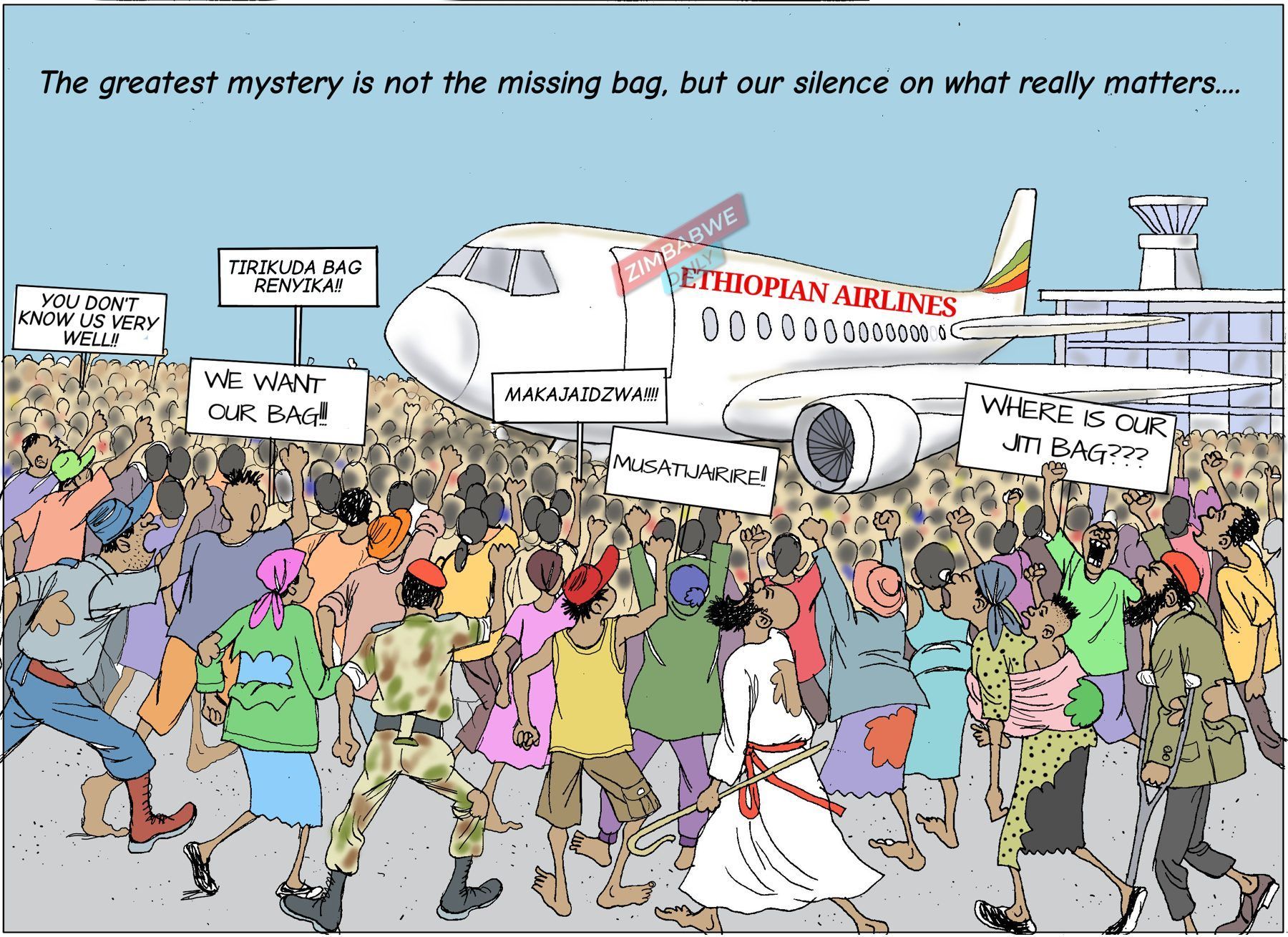
One of the cartoons here puts the point more bluntly: a crowd waving placards at an Ethiopian Airlines jet, under the line “The greatest mystery is not the missing bag, but our silence on what really matters”.
Now, the dancing
Baba Harare has since found himself in a different kind of dock. H-Metro, republished by Bulawayo24, reported a growing debate over whether the sexually suggestive lyrics and dance routines in his latest work dilute Jiti, one of the country’s oldest cultural traditions, whose birthplaces are widely held to include Murehwa.
The musician answered on Facebook. “Jiti did not begin with me. I inherited it. It is deeply rooted in Zimbabwe tradition. It has accompanied our people through celebrations and mourning for generations,” he wrote. “Our ancestors were not ashamed of who they were.”
The debate has also revived the memory of the genre’s pioneers, among them the late Biggie Tembo, Mike Mopo and Nevernay Chinyanga, known as Muyengwa, H-Metro noted.
The second cartoon here stages the argument as a trial in the “Court of Public Opinion”, with defence counsel pleading artistic freedom and the “Culture Defence Counsel” objecting that it is “cultural vandalism”.
The verdict, such as it is
There is no court, of course, and there will be no ruling. The bag is home. The amendment is law.
What July showed is that a determined online crowd can make a multinational airline find one suitcase in a matter of days. Whether that crowd ever turns its attention to the Constitution is, as Madhuku suggested, a question of organisation. For now, it remains the one piece of national luggage nobody has asked about.