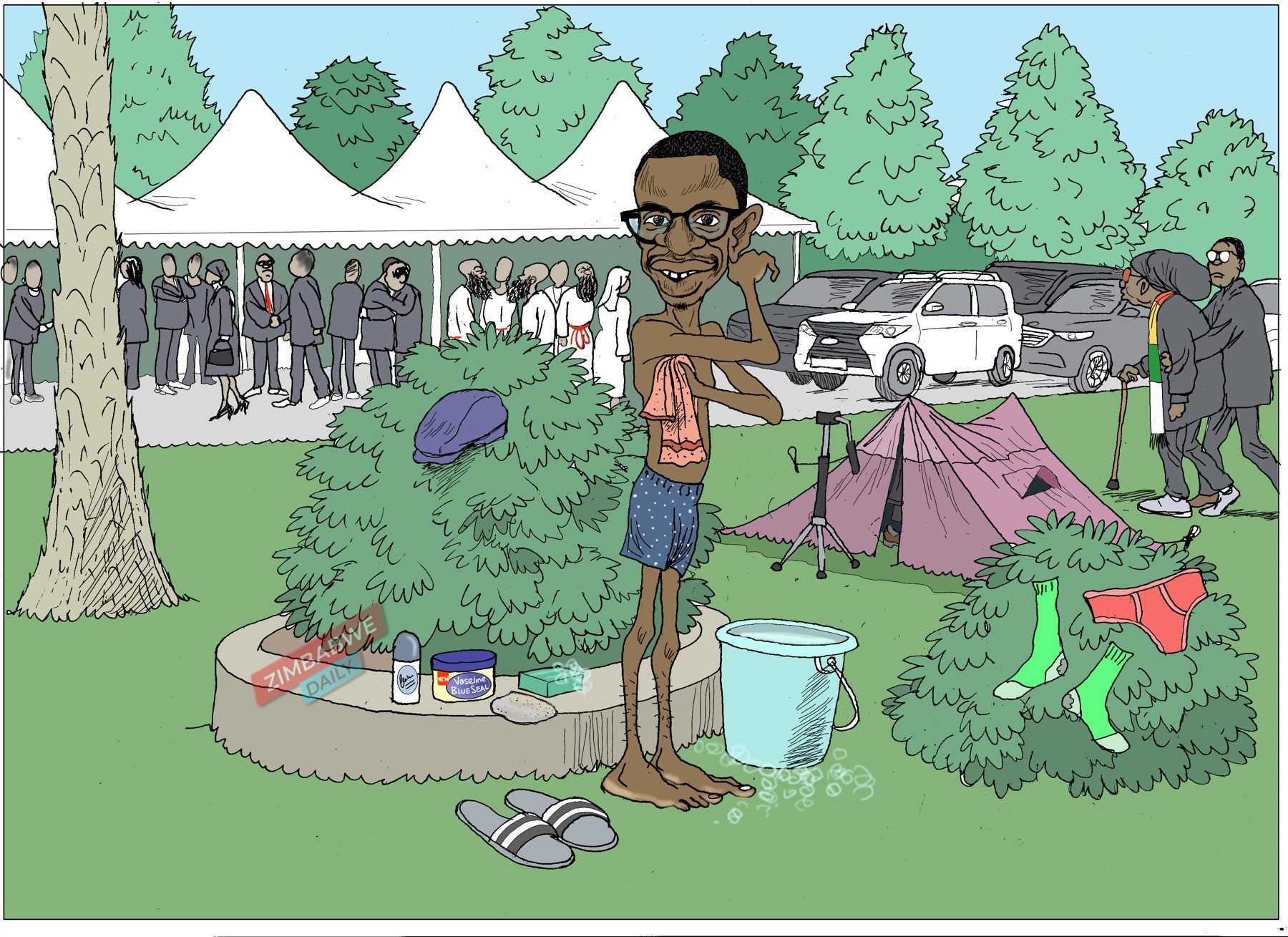
In the cartoon above, the scene looks like a wedding. White tents stretch across manicured lawns. Luxury vehicles, including Rolls-Royces and Mercedes-Benz sedans, line the drive. Well-dressed mourners mingle under the shade, some balancing plates of food, others sipping drinks.
But this is not a celebration of union. It is a funeral. And in Zimbabwe’s evolving culture of conspicuous mourning, death has become the ultimate status symbol.
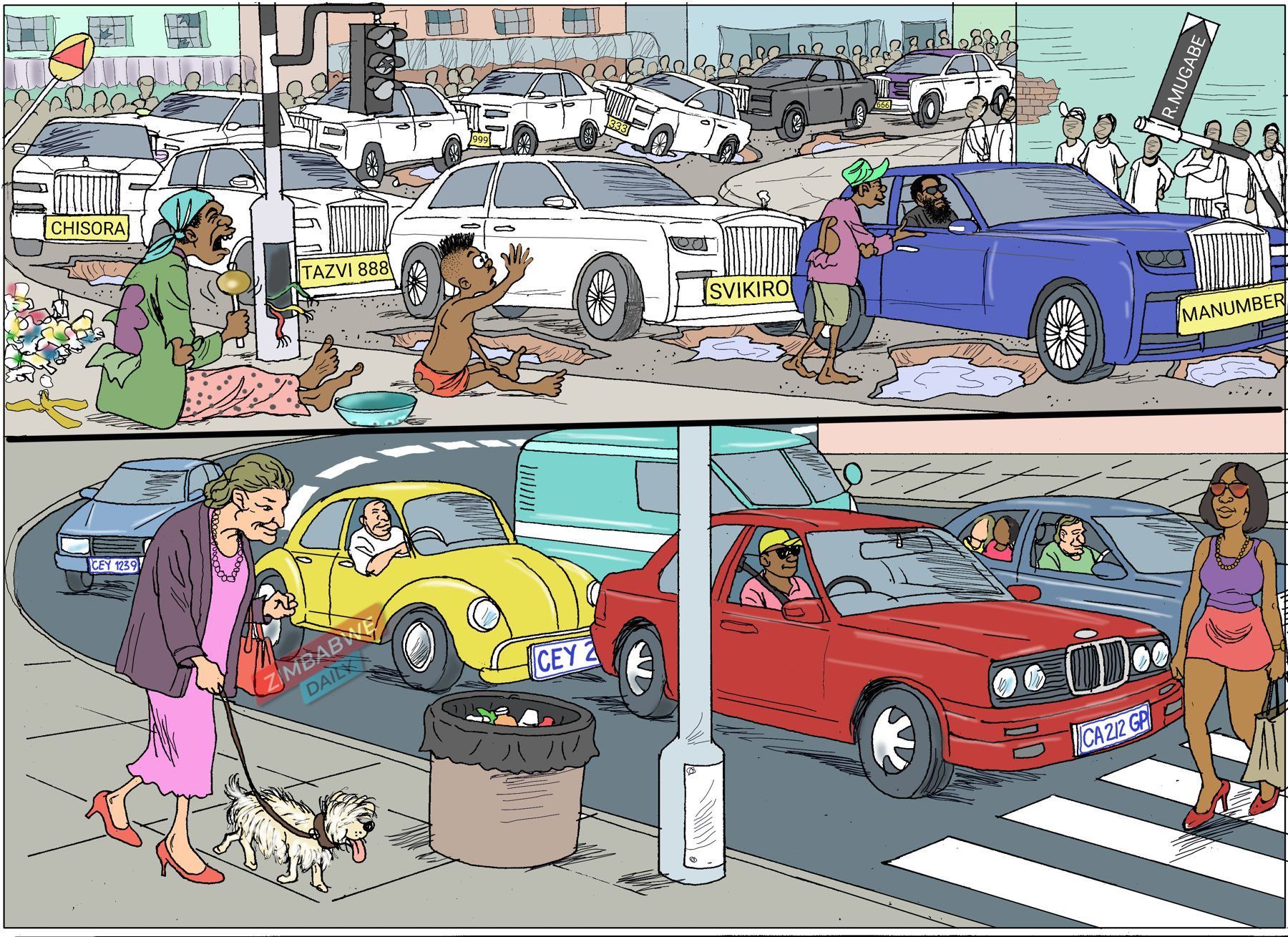
The funeral of businessman Wicknell Chivayo and his wife Lucy on 8 October 2026 set a new standard for lavish send-offs. Hundreds of people lined the route from Chivayo’s Gletwin mansion to Glen Forest Memorial Park, drawn by a procession of luxury vehicles that included at least half a dozen Rolls-Royces. On 7 October, the procession through Harare’s CBD brought parts of the city centre to a standstill, with mourners waving and calling out final farewells.
A group of bikers added to the spectacle. President Emmerson Mnangagwa visited the family homestead to offer condolences. Tanzanian President Samia Suluhu Hassan travelled quietly to Zimbabwe, while South African President Cyril Ramaphosa and Kenyan President William Ruto sent messages.
At Sahwira Glen Forest Memorial Park, the burial itself was a carefully staged production. The couple’s coffins were lowered simultaneously as a military bugler played Taps. Chivayo, who had been declared a provincial hero, received a state-assisted funeral that included a two-gun salute.
The trend is driven partly by economics. Zimbabwe’s funeral industry has exploded as millions choose funeral insurance over medical cover, recognising that a dignified burial is often more affordable than healthcare.
But it is also driven by status anxiety. In a society where wealth is concentrated among a small elite, funerals have become one of the few remaining opportunities to demonstrate social standing. A modest burial suggests poverty. A lavish one signals success, even if the deceased accumulated that wealth through questionable means.
Chivayo’s funeral illustrated the pattern. Despite corruption allegations, disputed government contracts and a public feud with Vice President Constantino Chiwenga, the businessman received a hero’s burial. Speakers praised his philanthropy and generosity. The procession of Rolls-Royces testified to his wealth. And the presence of political and religious leaders conferred legitimacy.
The contrast between Chivayo’s funeral and the struggles of ordinary Zimbabweans to afford basic burials was stark. Traditional burials in rural areas, where the deceased would be wrapped in animal skin and buried by the community, have given way to commercialised affairs where coffins, transport, food and tent hire must all be paid for.
Informal burial societies have stepped in to fill the gap, with community groups pooling resources to ensure members can afford dignified funerals. Some societies contribute US$120 towards a coffin, provide mealie-meal and vegetables, and even supply cooking utensils to support the bereaved. But these grassroots efforts cannot compete with the elite funerals that dominate media coverage.
“Culturally, we appreciate and celebrate life and transition [death], but in the modern day, we are forced to prepare for death more than life,” Marinda, a spiritualist and traditionalist, told Al Jazeera. “Traditionally, funerals and burials are facilitated by the society and the deceased would be buried covered in animal skin, but due to commercialisation, people are forced to pay for coffins.”
The commercialisation has also changed the meaning of mourning. What was once a communal expression of grief has become a performance. The thin man bathing on a lawn in the cartoon above, surrounded by tents and luxury cars, has become a symbol of how far Zimbabwe’s funeral culture has drifted from its origins.
As funerals grow more elaborate, the gap between the haves and have-nots widens. Elite burials with Rolls-Royces and military honours sit alongside paupers’ graves where families cannot afford even a simple coffin. The spectacle obscures the inequality, but it does not erase it.
Wicknell Chivayo’s funeral may have been the most lavish Zimbabwe has seen. But it will not be the last. As long as wealth remains concentrated among a small elite, and as long as death remains one of the few arenas where status can be publicly displayed, Zimbabwe’s funerals will continue to be spectacles.
Grief, it seems, has become a luxury good.