HARARE - Nine vendors appeared before a Harare magistrate this week, accused of throwing stones at municipal police officers. It is the latest skirmish in Operation Chenesa, the government-led drive to clear the capital’s pavements, and it suggests the war on clutter is turning into a war of attrition.
According to The Zimbabwean, magistrate Tapiwa Kuhudzai remanded the nine, aged between 17 and 43, in custody pending a bail hearing. The State alleges that on 26 September about 80 municipal police officers, “travelling in a convoy of three UD trucks”, descended on the corner of First Street and Speke Avenue. The accused allegedly urged other vendors to resist, and stones were thrown. “One of the stones struck the fender of a Nissan Almera belonging to POTRAZ, causing US$200 damage,” the State said.
Three were arrested at the scene. The others, the State alleges, marched to Town House, where police arrested them.
The operation in numbers
Operation Chenesa was launched on 9 September by Mayor Jacob Mafume and Local Government Minister Daniel Garwe. “We want a clean, Smart City and we are clear that we should restore Harare to what it used to be, if not even better,” Mafume said, according to the City of Harare. Vendors who want to trade in the central business district, he said, must move to designated places.
By 22 September, according to a Ministry of Local Government situation report cited by HararePost, 2,475 illegal businesses had been affected and 1,137 illegal structures removed. On a single day, 255 businesses were hit: 201 vending activities, 20 clothes sellers, 11 snooker businesses, four furniture businesses, four tyre businesses and one car wash. Among the structures removed were 36 billboards, four vending stalls and six gazebos.
The report also recorded 32 arrests, 148 verbal warnings and 239 fines totalling US$2,570, which works out at a little under US$11 a fine. The operation involved 141 personnel and 20 vehicles and pieces of equipment.
The ministry itself acknowledged the limits of force. It called for continued enforcement to stop traders from reoccupying cleared spaces, but also for “sustained dialogue with affected traders” and faster preparation of authorised alternative markets.
The comeback
The traders have not waited for the markets. Writing in Nehanda Radio, Dr Phillan Zamchiya described vendors returning to central Harare “barely two weeks after the launch”. He wrote that The Herald had reported vendors back on First Street Mall, Robert Mugabe Road and parts of Fourth Street, and that Garwe had acknowledged people returning to cleared areas at night.
Mafume himself has lowered expectations. “We are not Jesus of Nazareth. We can’t clear vendors in the City of Harare in one day,” he told journalists, as quoted by Zamchiya.
Zamchiya describes the tactics: whistles of different pitches warning of municipal police, WhatsApp groups tracking the movements of officials, car boots that become shops and then cars again, and stock hidden in nearby shops while only a few tomatoes sit on display. “The state clears, people wait; the state moves on, and people return,” he wrote.
The cartoons’ view
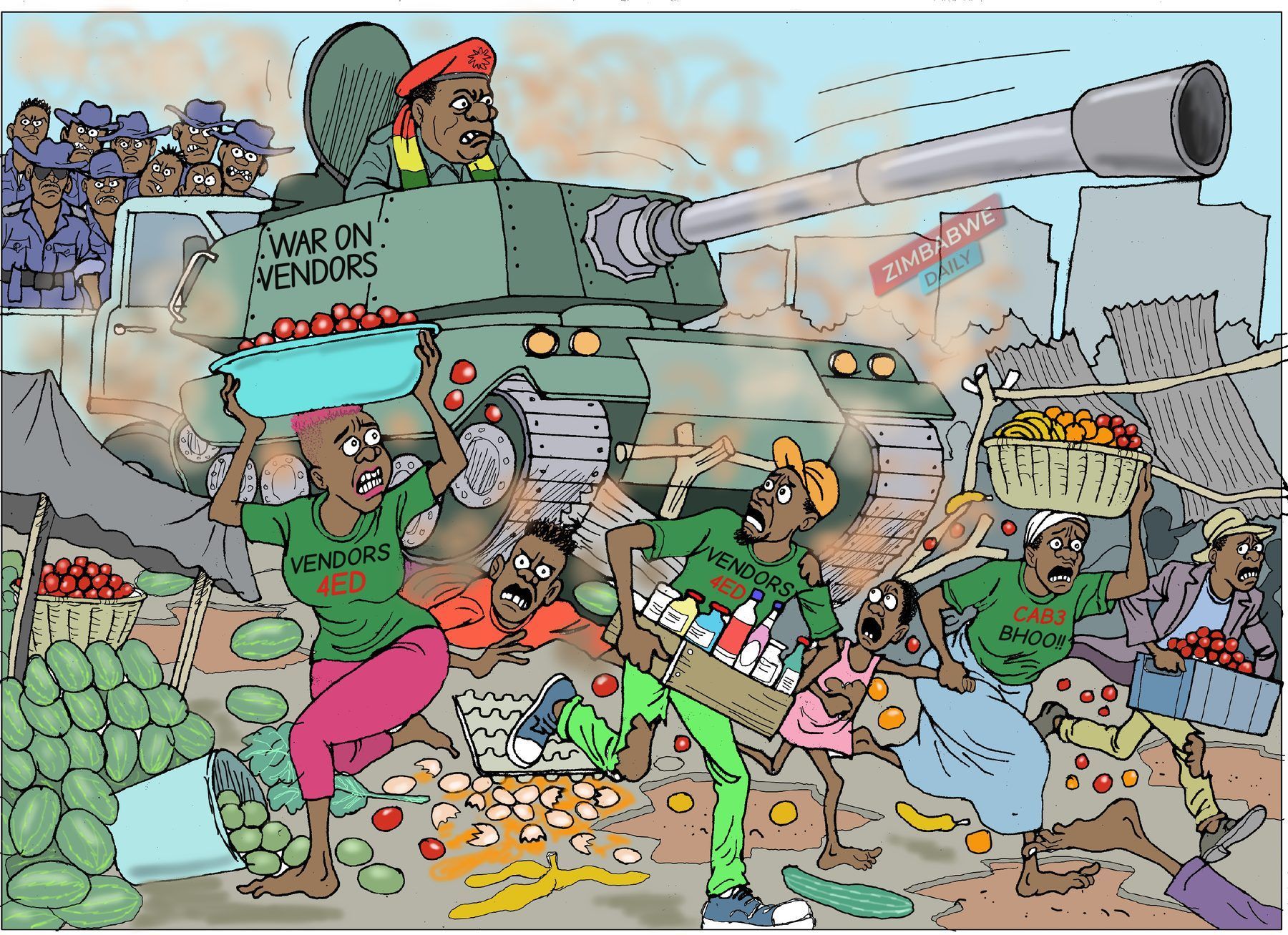
The cartoons accompanying this story take the vendors’ side without apology. One shows a tank marked “WAR ON VENDORS” rolling through a market as traders in “VENDORS 4ED” T-shirts flee with their wares. Another, wordless, shows an officer hammering apart a fruit stall as a woman and child watch.
There are no tanks in the official situation reports, which speak of billboards, gazebos and snooker tables. But the reports do list vending stalls among the structures removed, and the hammer is not hard to imagine.
What comes next
The operation, the ministry says, remains ongoing, with joint teams deployed daily. The nine accused were due back in court for their bail hearing. If the pattern Zamchiya describes holds, the vendors will be back on the pavement by lunchtime.
Harare may yet become the clean, smart city its mayor wants. The open question is where its tomato sellers are supposed to stand while it does.