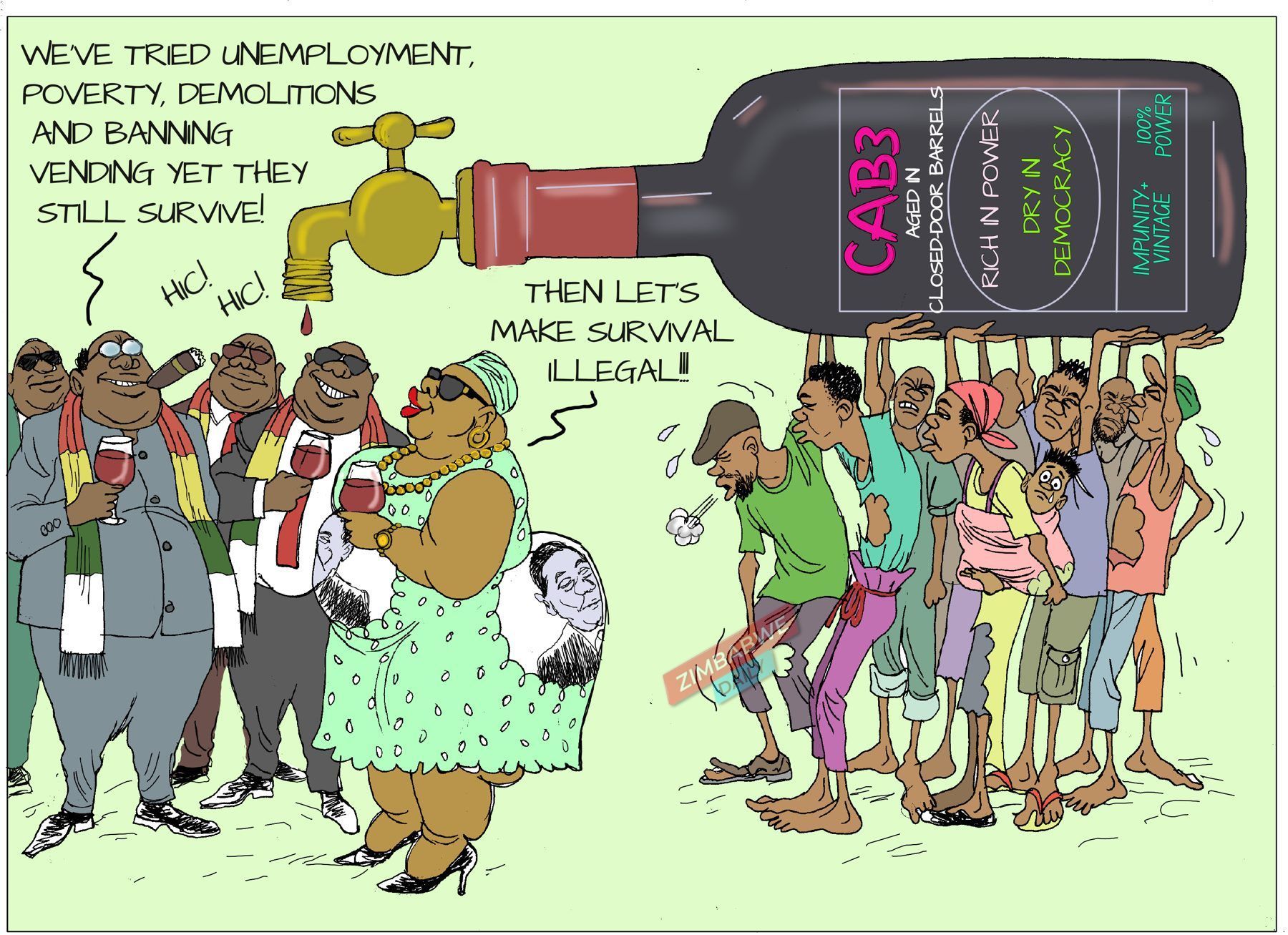
They have tried everything else. Unemployment, poverty, demolitions, banning street vending. Now the government has found a new way to make survival illegal: rewriting the constitution to keep itself in power.
On 7 July 2026, President Emmerson Mnangagwa signed the Constitution of Zimbabwe Amendment (No. 3) Act into law. Known as CAB3, the amendment extends presidential and parliamentary terms from five to seven years, allowing Mnangagwa to remain in office until 2030. It also changes the method of electing the president from a direct popular vote to election by Parliament.
For many Zimbabweans, CAB3 is not just a legal change. It is the final insult in a long list of policies that have made daily life unbearable.
“We’ve tried unemployment, poverty, demolitions and banning vending, yet they still survive,” reads the caption of the cartoon above. “Then let’s make survival illegal!”
The passage of CAB3 was mired in controversy from the start. In the closing stages of debate, reports emerged that three Members of Parliament who backed the bill, two from the opposition and one from ZANU-PF, had each received a Toyota Fortuner and US$50,000 from businessman Wicknell Chivayo. The gifts drew accusations of bribery from former legislator Temba Mliswa, who publicly feuded with Chivayo over the payments.
Bulawayo Mayor David Coltart questioned Parliament’s failure to enact asset declaration laws. In early July, war veteran Reuben Zulu filed an urgent High Court application to halt the bill’s certification over the same gifts. Vice President Constantino Chiwenga made public interventions widely read as opposition to CAB3 proceeding without a referendum.
Despite these challenges, Mnangagwa signed the bill into law. Opposition figures, including Tendai Biti and the Movement for Democratic Change, vowed to challenge the Act in the Constitutional Court, arguing that provisions extending presidential and parliamentary terms should have been put to a national referendum.
Their legal case rests on Section 328 of the Constitution, which requires a referendum for amendments affecting the Bill of Rights or altering the terms of sitting officials. “Because it affects the right to vote, which is in the Bill of Rights, the bill must have been subjected to referendum first,” MDC leader Douglas Mwonzora said.
Constitutional watchdog Veritas went further, arguing that the entire Act is null and void because it was not put to a referendum. “For these reasons, sections 5(b) and 10(b) of the Act … are invalid because they were not approved by voters at a national referendum,” Veritas wrote in a legal analysis.
The government rejected the criticism. The government said the changes would strengthen governance and bring political stability, and argued that they alter the electoral cycle rather than term limits, so no referendum is needed.
Critics described CAB3 as an attempt to extend President Mnangagwa’s tenure beyond 2028, according to Pindula.
The amendment’s timing also raised eyebrows. Speculation that Mnangagwa intended to stay beyond his second term first emerged around two years ago, when supporters at ZANU-PF rallies began chanting “2030 he will still be the leader.” The slogan became known as the “2030 agenda,” a coded reference to Mnangagwa’s ambition to extend his rule.
Party leaders endorsed the constitutional amendment, and the Cabinet approved it in February 2026 before it was passed by both houses of Parliament. The bill sailed through with backing from the ruling ZANU-PF party, which controls Parliament, and faced only token resistance from a weakened opposition.
Street vendors have been targeted with crackdowns and evictions.
The Constitutional Court had set 23 September to hear the MDC’s challenge, but on 21 September the party said the hearing had been postponed indefinitely, with no new date and no reason given.
For now, CAB3 is the law of the land. And Zimbabweans, who have endured so much, are being asked to swallow one more bitter pill.