The optics were brutal. President Emmerson Mnangagwa stood at the podium of the United Nations General Assembly on 24 September, delivering Zimbabwe’s vision for its upcoming Security Council term. Behind him, row after row of empty green chairs stretched across the vast hall.
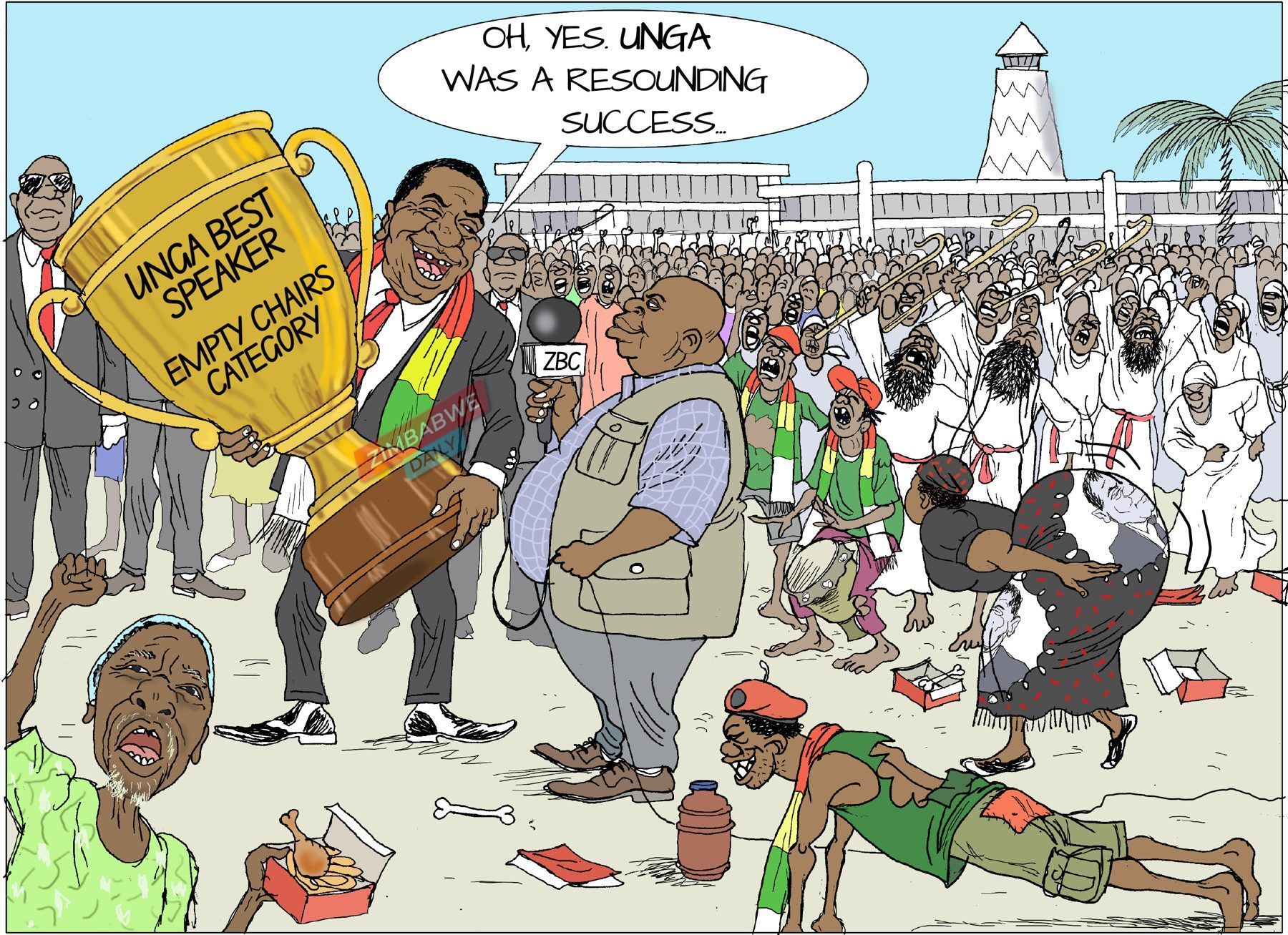
Video of the speech quickly went viral, with Zimbabweans mocking the “empty chairs” spectacle. Social media was flooded with satirical commentary about the sparse attendance.
Presidential spokesperson George Charamba hit back furiously, dismissing critics as illiterate and arguing that sparse attendance is routine at UNGA. Writing under his well-known X handle @Jamwanda2, Charamba argued that delegations juggle bilateral meetings and that the real audience watches via broadcast. He accused critics of dishonesty and a lack of understanding of how the United Nations works.
Mnangagwa himself seemed unbothered. Speaking at the Robert Gabriel Mugabe International Airport upon his return, the president said Zimbabwe is now highly regarded internationally, citing his allocation to address first as proof.
But the “empty chairs” narrative was not new. Similar visuals have followed Mnangagwa to New York before, at UNGA74 in 2019, UNGA78 in 2023, and now UNGA81. Each time, the response is the same: government officials insist the sparse attendance is normal.
In his speech, Mnangagwa outlined Zimbabwe’s priorities ahead of its 2027 to 2028 term on the UN Security Council. He called for reform of the Security Council, the universal application of international law, and a multilateral system in which peace and dialogue, rather than war and confrontation, shaped international relations.
“As the current crop of leaders, it should concern us that today, somewhere, a child is born into war, a family is displaced by conflict, a farmer loses another harvest to drought, and a young person wonders whether technological progress will expand opportunity or deepen inequality,” Mnangagwa said.
He pledged that Zimbabwe would use its Security Council seat to advance Africa’s interests, amplify the voice of developing countries in global decision-making, and promote preventive diplomacy and African-led peace operations.
The speech was well-crafted and covered important themes. But it was delivered to an audience that was mostly not there.
Charamba argued that the hall is routinely empty as delegations juggle bilateral side meetings, and that the real audience watches on live broadcast. To make his point, he posted videos of other leaders addressing near-empty seats at UNGA81, including Ghana’s John Mahama, Britain’s Keir Starmer, France’s Emmanuel Macron and Turkey’s Recep Tayyip Erdogan.
Still, perception matters. And the perception of a Zimbabwean president speaking to empty chairs feeds a narrative that the country is isolated, its leader sidelined, and its voice ignored.
Charamba’s defence, while technically accurate, missed the broader point. Yes, other leaders also address sparse crowds. But for Zimbabwe, a country seeking to rebuild its global reputation and leverage its Security Council seat, the empty hall was a missed opportunity to project confidence and relevance.
The irony was not lost on Zimbabweans. At home, Mnangagwa’s government had just extended his presidency to 2030 through a controversial constitutional amendment. Abroad, he could not fill a room.
For now, the “empty chairs” meme endures, a visual shorthand for Zimbabwe’s place in the world and Mnangagwa’s struggle to command respect beyond the borders he controls.