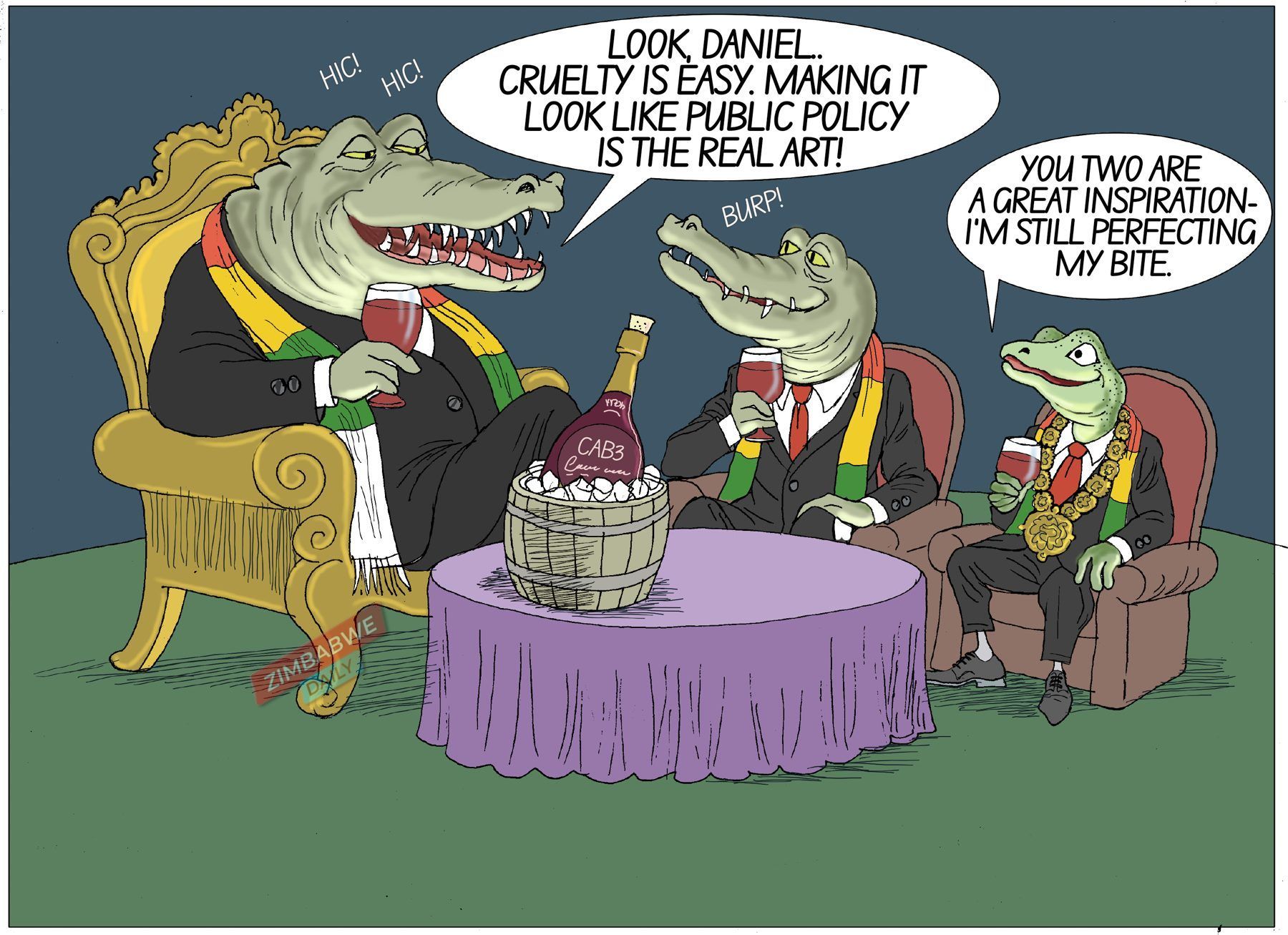
The cartoon’s caption reads: “Look, Daniel. Cruelty is easy. Making it look like public policy is the real art!”
The line, dripping with cynicism, captures something essential about Zimbabwe’s governance in 2026. Policies that hurt ordinary people are packaged as necessary reforms, painted with the language of order, health and development. The pain is real. The justifications are hollow. And the architects seem unbothered by the contradiction.
Take Operation Chenesa, the government’s latest crackdown on street vendors. Launched in September 2026, the operation aims to remove informal traders from Harare’s pavements and relocate them to designated markets. The stated goal is to restore order, improve sanitation and reduce congestion in the central business district.
On paper, it sounds reasonable. In practice, it has been brutal. Municipal police have clashed violently with vendors, who threw stones and damaged property. Officers were injured. Vendors were arrested and had their goods seized. The confrontations turned Harare’s streets into a battleground, with traders scattering when enforcement teams arrived, only to return when officers left.
Vendors say the designated markets lack the customers they need to survive. The government’s answer is clear: obey the law or face consequences. But when the law makes survival illegal, and the alternative is starvation, can that really be called governance?
The same pattern applies to the crackdown on codeine-based cough syrups. Police have intercepted a truck at Beitbridge and a minibus stuffed with Broncleer and Benylin, and even found bottles hidden in coffins carrying dead bodies, arresting the smugglers and seizing thousands of bottles. Police said the medicines are unregistered in Zimbabwe, making their possession and sale illegal.
The policy is framed as protecting public health. And there is truth to that. Codeine abuse is a real problem, causing addiction, hallucinations and even death. But the crackdown targets street-level dealers and desperate users while ignoring the political and economic conditions that drive people to abuse drugs in the first place.
Unemployment is rampant. Opportunities are scarce. The future looks bleak. In that context, criminalising codeine without addressing the underlying despair feels like treating the symptom and ignoring the disease.
Then there is CAB3, the Constitution Amendment that extends President Emmerson Mnangagwa’s rule to 2030. The government insists the amendment is about stability and governance. It looks like a naked power grab disguised as constitutional reform.
The amendment was passed by Parliament, where ZANU-PF holds a commanding majority. It was signed into law by Mnangagwa himself. But it was never put to a referendum, despite provisions in the Constitution requiring public approval for changes that affect the Bill of Rights or extend the terms of sitting officials.
The government’s defence is that the amendment changes the electoral cycle rather than term limits, so no referendum is required. Veritas disagrees, arguing that the entire Act is null and void because it bypassed the referendum requirement.
But the law is now in force, and Mnangagwa will remain in office until 2030. The cruelty here is not physical. It is the slow erosion of democratic accountability, the quiet theft of the people’s right to choose their leaders. And it is dressed up as legal reform, complete with government gazettes and parliamentary debates.
What ties these policies together is the gap between their stated purpose and their actual effect. Operation Chenesa is supposed to restore order, but it has sparked chaos and violence. The codeine crackdown is supposed to protect health, but it criminalises desperation. CAB3 is supposed to bring stability, but it entrenches a leader who has failed to deliver prosperity.
The art, as the saying goes, is making cruelty look like public policy. Zimbabwe’s government has mastered it. They ban vending and call it urban planning. They extend presidential terms and call it constitutional reform. They crack down on codeine and call it public health.
Meanwhile, ordinary Zimbabweans are left to navigate a system designed to punish them for trying to survive. Vendors are arrested for throwing stones at officers.
At some point, the language of governance stops mattering. When policies consistently harm the people they are supposed to serve, when the gap between rhetoric and reality grows too wide to ignore, the cruelty becomes undeniable.
And no amount of careful phrasing can disguise it.