HARARE - Zimbabwe has finally qualified for something. Unfortunately, it is a suspension.
The FIFA Council on Thursday suspended the Zimbabwe Football Association (ZIFA) with immediate effect, citing “flagrant violations of the FIFA Statutes”. The letter, signed by FIFA Secretary-General Fatma Samoura and addressed to ZIFA General Secretary Joseph Mamutse, said the country’s football body “loses all its membership rights as of 24 February 2022 until further notice”.
The practical meaning is stark. ZIFA representatives and club teams, the letter said, “are therefore no longer entitled to take part in international competitions until the suspension is lifted.” ZIFA and its members are also cut off from FIFA and CAF development programmes, courses and training.
How it came to this
The dispute is about who runs Zimbabwean football. FIFA’s statutes forbid “undue interference” by third parties, including governments. Zimbabwe’s Sports and Recreation Commission (SRC), the state regulator, has moved against ZIFA’s leadership step by step.
According to FIFA’s account, the SRC suspended ZIFA’s general secretary in November 2020. In November 2021 it suspended the ZIFA board led by Felton Kamambo, citing “several incidences of gross incompetence contrary to the national interest”. In December it set up a restructuring committee in the board’s place.
FIFA says it warned repeatedly. A roadmap was discussed; a Zoom meeting was planned. In February the ZIFA president was barred from travelling to Cameroon for the Africa Cup of Nations final, and he, three board members and the general secretary were summoned to court over alleged misuse of ZIFA letterheads. The court granted them bail on conditions that included surrendering their passports and staying away from ZIFA headquarters.
The FIFA Council called this “a clear case of undue interference by a third party”. To lift the ban, it wants the SRC’s suspensions repealed, the restructuring committee scrapped, Kamambo’s administration back in full control and the letterhead complaint withdrawn.
The SRC does not blink
The SRC’s reply, signed by its chairman Gerald Mlotshwa, was not the language of retreat. It said it would not reinstate the suspended board. It accused FIFA of being “constrained by the provisions of its own statutes to protect certain of the undoubted sexual predators, fraudsters, and corrupt administrators at the helm of football administration in Zimbabwe.”
The commission said some of those administrators face charges including sexual harassment, bribery and fraud before Zimbabwe’s courts, and that FIFA and CAF had known for eighteen months about the alleged harassment of female referees without acting. FIFA, for its part, said in its letter that it remains committed to cooperating with “any ongoing investigations regarding alleged sexual harassment and bribery by ZIFA officials”.
“FIFA statutes are not a part of the laws of Zimbabwe,” the SRC said, adding that ZIFA “will return to the ‘FIFA Family’ when it is in a condition fit to do so.” Domestic football, it promised, will continue.
The ball and the chain
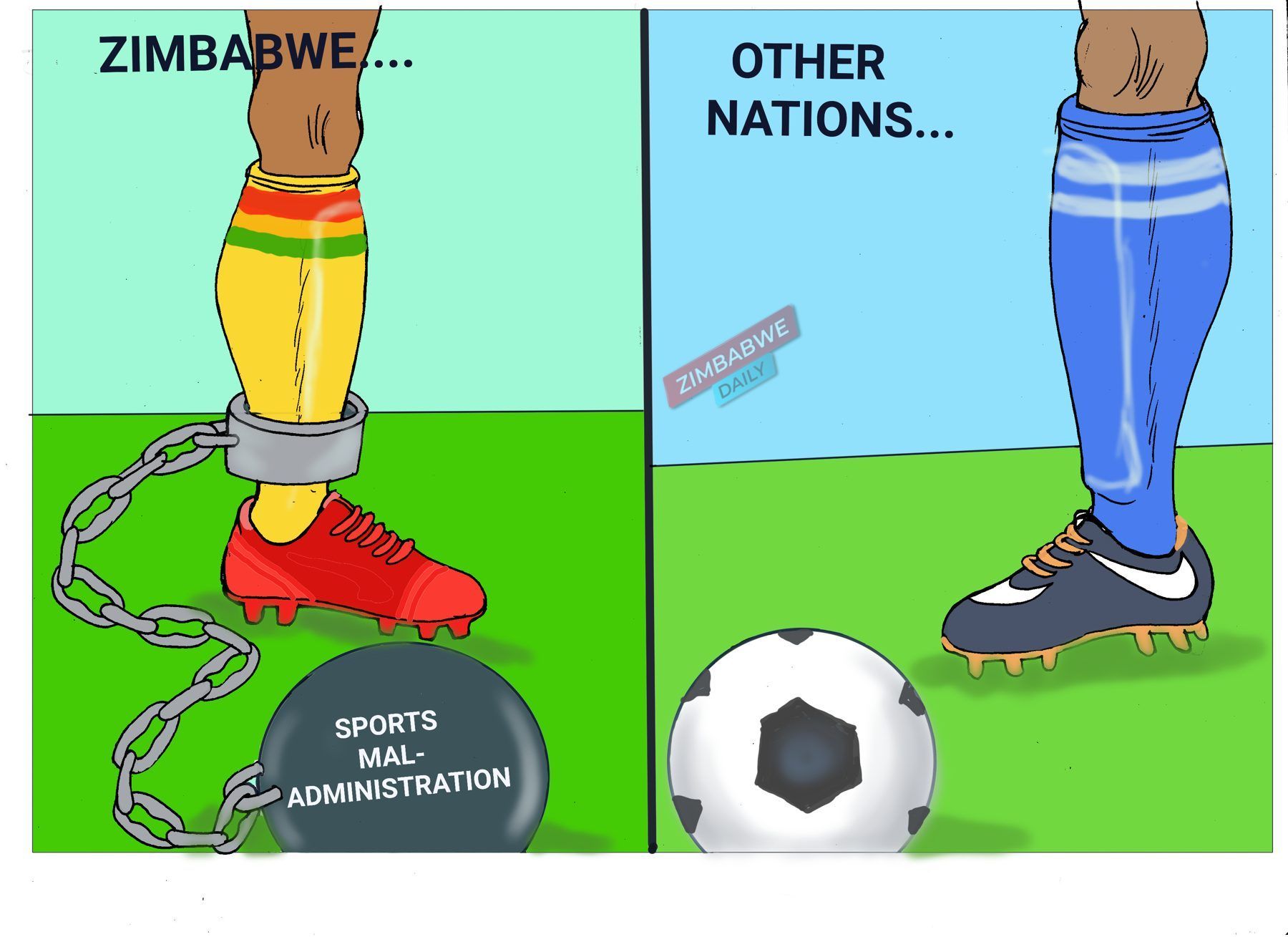
A cartoon published last month put the problem in one frame: a Zimbabwean boot shackled to an iron ball labelled “sports mal-administration”, while other nations simply get a football. It is a harsh picture. It is also hard to argue with the scoreline.
There is a real cost to a fight in which both sides claim the moral high ground. The players, who had no say in the board’s suspension, now have no international fixtures to play.
Postscript, July 2023
The ban would last almost 17 months. In July 2023, FIFA’s Bureau lifted the suspension and installed a normalisation committee chaired by former Dynamos FC chairman Lincoln Mutasa, with a deadline of 30 June 2024 to restructure ZIFA and organise elections. By then, BBC Sport reported, Zimbabwe had been excluded from the qualifiers for the 2023 Africa Cup of Nations and the 2024 Women’s Afcon, among other competitions.
Sports minister Kirsty Coventry defended the long standoff. “It was hard, but it was worth it,” she said. “When we are winning tournaments, we will all be saying that it was worth that small window of pain.”
A later cartoon, set at Rufaro Stadium, has a fan asking the question that still hangs over the game: “Is this not why FIFA banned us??” With the ban over, BBC Sport noted, concerns turned to the country having no stadium approved to host international football. That is another story.