HARARE - Zimbabwe’s liberation war ended in 1980. Its recruitment drive, it appears, is still open.
The government plans to pay one-off gratuities and monthly pensions to a new batch of about 160,000 war veterans, war collaborators and former political prisoners who missed out on the first round of compensation in 1997, ZimLive reported.
In a notice issued on Saturday, the Ministry of Defence and War Veterans said it had vetted 165,130 of the 207,103 people who applied in the latest round. Of those, 144,200, or 87.3 percent, were successful, 20,930 were rejected and 41,973 applications were still being considered. Applying the same success rate, ZimLive projected that more than 162,400 people could be in line for the new payouts.
The vetting ran from 17 March to 6 April, the ministry said. Names of successful applicants are to be published in the Government Gazette, and those turned down can appeal to the Veterans of the Liberation Struggle Board within 30 days of publication.
The window has not closed. Defence Minister Oppah Muchinguri-Kashiri said anyone who still wishes to be vetted has until 31 August to submit details to district and provincial offices of the Department of War Veterans Affairs. “Among those who missed out are veterans in the diaspora who should also submit their details at our embassies around the world,” she said, according to ZimLive.
The arithmetic of 1997
Zimbabweans of a certain age will recognise the tune. In 1997, after months of protests by veterans of the 1970s war, the government paid out unbudgeted gratuities of Z$50,000 (then about US$4,300) each, along with monthly pensions initially pegged at Z$2,000, ZimLive reported. On 14 November 1997, the Zimbabwe dollar plunged 72 percent against the US dollar, a sudden devaluation that the outlet described as having “set in motion the country’s eventual economic collapse.”
ZimEye noted that the local currency “has never recovered.”
This time, the money has not yet been found. Finance Minister Mthuli Ncube did not budget for the compensation in the current financial year, according to ZimLive, which suggested that any payments would come in the new year.
And the timing
The new year is 2023, which is also election year. Both outlets drew the connection. ZimLive said the timing of the announcement, just months before next year’s general elections, “will raise vote-buying concerns in the opposition.” ZimEye said the timing came as the economy was “heading south” and “just months ahead of general elections next year.”
Since 1997, according to ZimLive, unvetted veterans and collaborators had grown despondent at countless unfulfilled promises of compensation. For them, the announcement is overdue recognition. For the Treasury, it is a liability of uncertain size arriving at an awkward moment.
The ark and the table
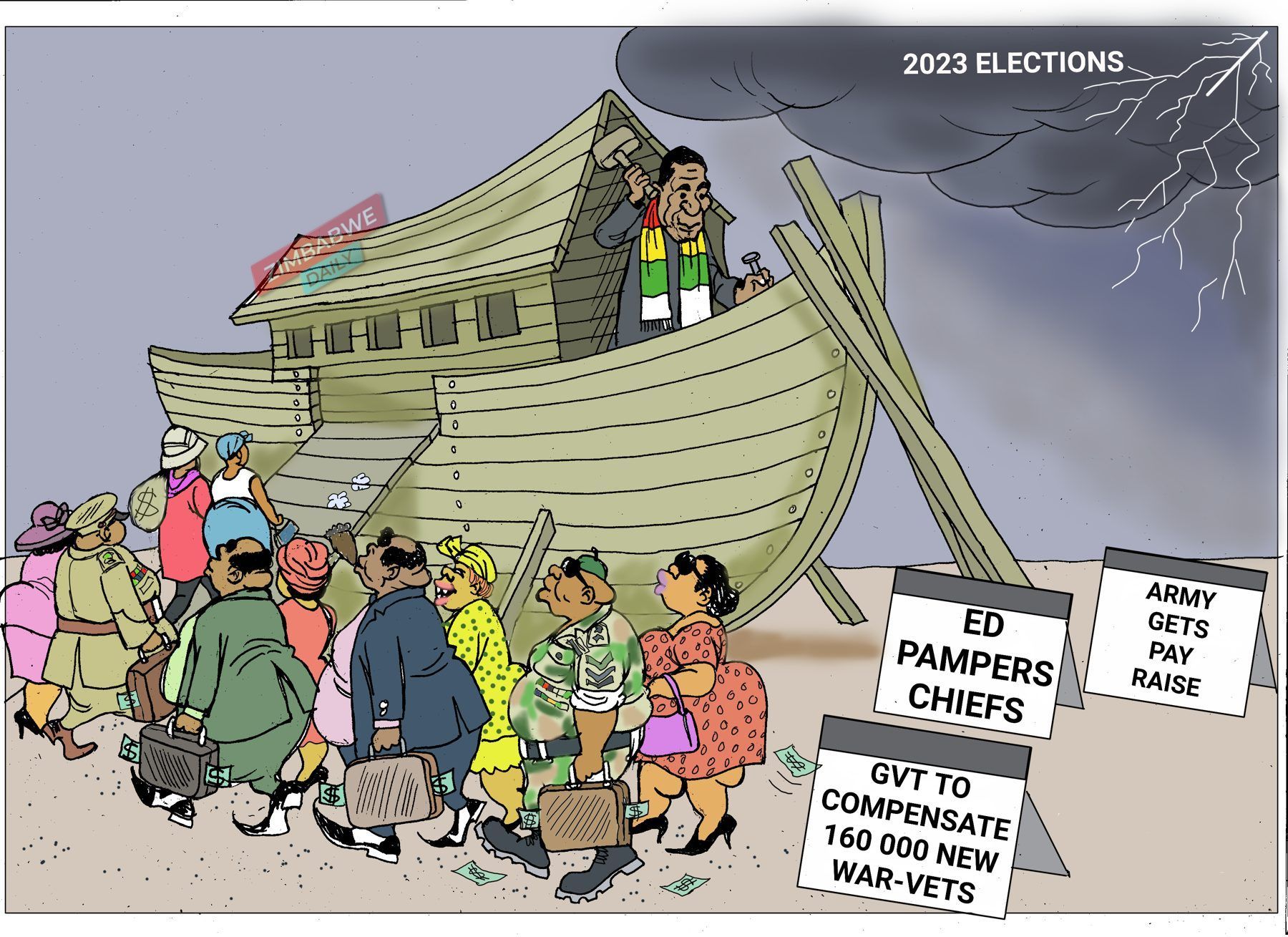
One of the cartoons reproduced here sets the announcement aboard a Noah’s Ark labelled “2023 ELECTIONS”, sailing past signs about chiefs being pampered, the army getting a pay rise and 160,000 new war veterans being compensated. It is a cartoonist’s shorthand for a pre-election season in which, as the drawing has it, every constituency gets its own plank.
The second cartoon, drawn years later, reduces the argument to a ragged veteran on a crutch and a well-fed man in a party scarf, shouting past each other: “We died for this country!” and “We eat for this country!” It is not tied to any one announcement. It is offered here because the same quarrel, between sacrifice and entitlement, sits underneath every list of names the ministry publishes.
What happens next
The ministry’s next step is the Gazette, and the next deadline is 31 August. The Treasury’s next step is less clear.
What is clear is that the list of people the state recognises as veterans of the liberation struggle is still growing, 42 years after independence. That is not, strictly speaking, a contradiction: the scheme covers collaborators and former detainees as well as fighters. But it does make the 1997 file worth reopening, if only to read the last page.