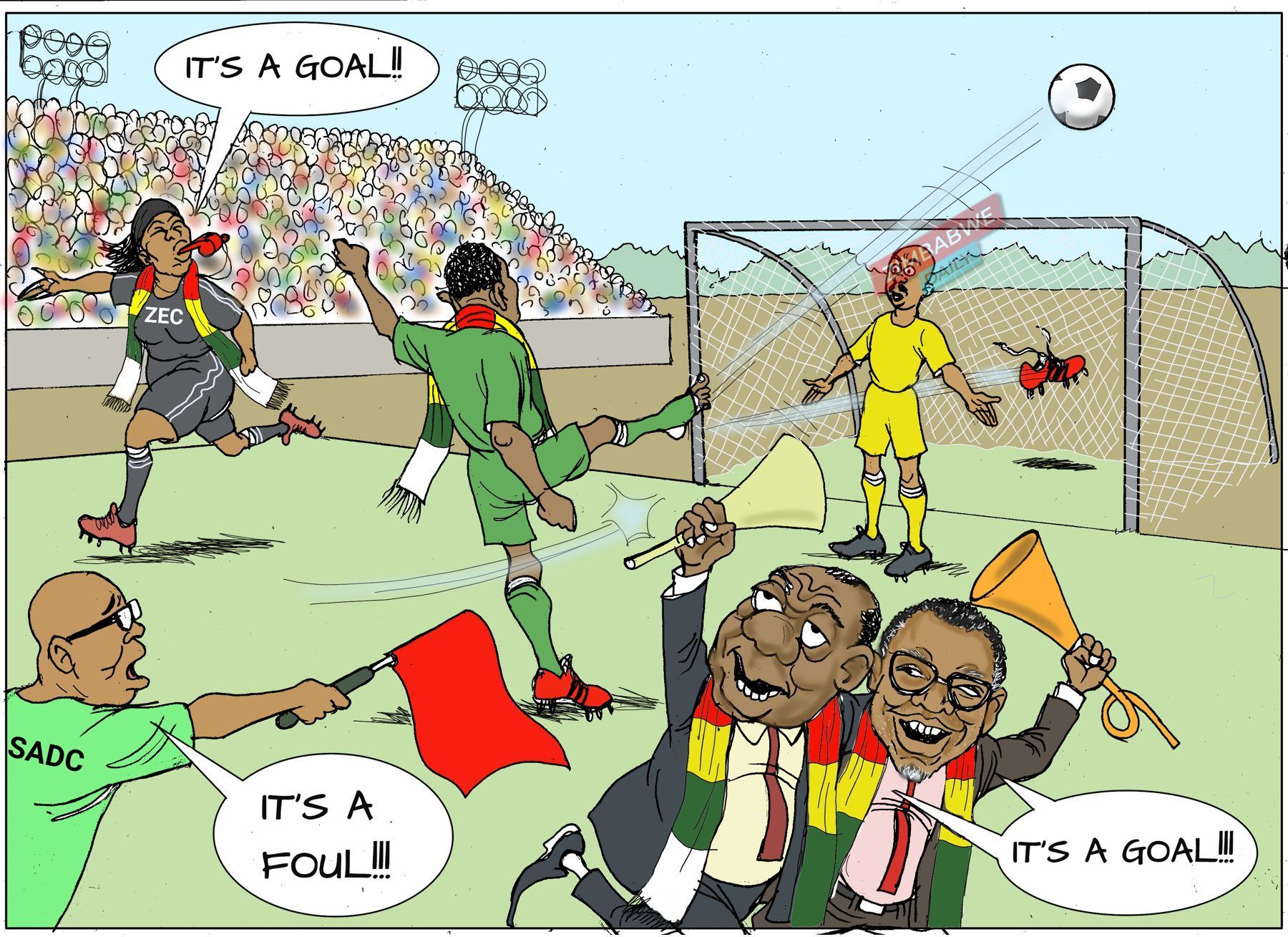
HARARE - In football, the referee usually has the last word. In Zimbabwe’s 2023 election, the Zimbabwe Electoral Commission blew the final whistle, but the linesman from the Southern African Development Community had already raised his flag.
Late on Saturday, ZEC declared President Emmerson Mnangagwa the winner of the presidential election with 52.6 percent of the vote, the BBC reported. His main challenger, Nelson Chamisa of the Citizens’ Coalition for Change, received 44 percent. According to ZEC, Mnangagwa won more than 2.3 million votes to Chamisa’s 1.9 million, on a turnout of 69 percent. ZANU-PF was also declared the winner of the parliamentary race, with 136 of the 210 constituency seats to the CCC’s 73.
Chamisa rejected the outcome. “We have won this election. We are the leaders. We are even surprised why Mnangagwa has been declared a leader,” he told journalists in Harare, the BBC reported.
An unusual flag
What made this election different was not the opposition’s objection but the regional bloc’s.
On Friday, the SADC Electoral Observation Mission, led by former Zambian Vice President Nevers Mumba, released its preliminary statement. The mission said the pre-election and voting phases on 23 and 24 August had been peaceful and calm. “However,” it concluded, “the Mission noted that some aspects of the Harmonised Elections, fell short of the requirements of the Constitution of Zimbabwe, the Electoral Act, and the SADC Principles and Guidelines Governing Democratic Elections (2021).”
The Observer, a Harare news site, called it an unprecedented criticism of a Zimbabwean election by SADC.
What the observers saw
The mission had 68 observers, 50 of whom were deployed across Zimbabwe’s ten provinces, and it reported on 172 polling stations. Of the stations it observed, 64 percent opened on time and 36 percent did not, with some opening more than 12 hours late. ZEC attributed the delays to the unavailability of ballot papers, particularly for local authority elections, a problem the mission said was specific to Harare and Bulawayo. Some voters left without voting. By 6am on 24 August, some in those two provinces had still not cast their ballots.
The mission also recorded allegations of intimidation in rural areas attributed to a group called Forever Associates Zimbabwe, or FAZ, which it said was described as a quasi-security intelligence organisation. It raised concerns about the amendment commonly referred to as the Patriot Act, and, according to The Observer, said state media coverage had favoured one party.
“Before election day, ZEC had assured our mission, and other stakeholders, that all necessary voting materials, including ballots, were available and ready for use,” Mumba said, The Observer reported. “The subsequent information from ZEC that they did not have adequate ballot papers has the unfortunate effect of creating doubts about the credibility of this process.”
The race, as drawn
Months before polling day, one of the cartoons reproduced here imagined the contest as “THE 2 HORSE RACE”, in which one horse carries a dozen ruling-party jockeys and is towed along by a rope while an election official watches. A second, drawn after the SADC statement, shows a linesman flagging a foul while officials on the bench celebrate a goal with vuvuzelas.
Both are satire. But the second is closer to the record than most cartoons get. The BBC reported that observer missions from the EU, the Commonwealth and SADC raised concerns about the banning of opposition rallies, issues with the electoral register, biased state media coverage and voter intimidation.
What happens next
SADC’s mission said it would release its final report after the validation and proclamation of final results. ZEC has declared its result. The CCC says it has the “real results”.
As any Zimbabwean football fan will tell you, a goal stands once the referee says so, however loudly the linesman waves his flag. Whether anyone in the stands believes it is another matter.