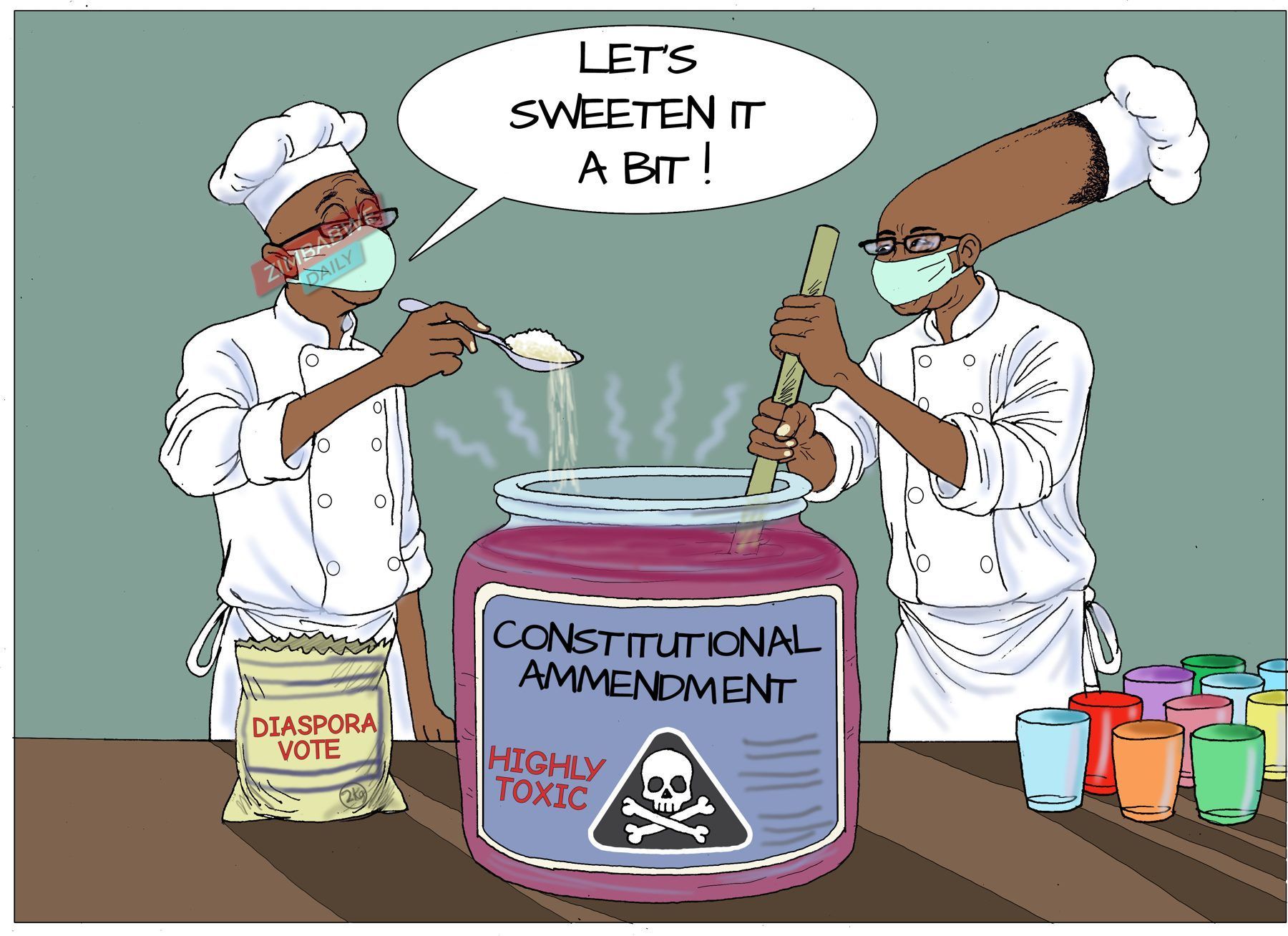
HARARE - Every good cook knows that a bitter dish can be rescued with a little sugar. Zimbabwe’s constitutional kitchen appears to have learned the same trick.
A week after the Constitution of Zimbabwe Amendment (No. 3) Bill was published in a Government Gazette Extraordinary on 16 February, opening the mandatory 90-day period of public consultation, the government’s case for it has acquired a sweetener: votes for Zimbabweans abroad.
Justice, Legal and Parliamentary Affairs Minister Ziyambi Ziyambi indicated last week that diaspora voting would be possible only after the Bill is passed and the Electoral Act is changed, NewZimbabwe.com reported.
The Bill itself is about rather larger things. As gazetted, it would extend the terms of the President, Parliament and local authorities from five to seven years and replace the direct election of the President with election by a joint sitting of Parliament.
The campaigners are not buying
The Zimbabwe Diaspora Vote Initiative rejected the link in a statement on Monday. Diaspora voting, it said, is already provided for under Section 67 of the Constitution and does not depend on the amendment.
“We find this difficult to understand as nothing in the proposed Constitutional Amendment Number 3 Bill applies to the issue of Diaspora Voting,” the group said, according to NewZimbabwe.com.
The group then took the minister’s words and turned them back on him. “As the Minister correctly points out, only an amendment of the Electoral Act is necessary to enable Zimbabweans living in the Diaspora to vote. We are delighted that the Minister has finally agreed that it is only the Electoral Act that needs to be amended,” it said.
It went further, insisting that Zimbabweans abroad must be allowed to vote in any referendum on the Bill. “We reiterate our earlier position that Zimbabweans living outside the country must participate in the constitutionally required referendum to decide on the proposed amendments,” the statement said. “If the majority of Zimbabweans vote for such in the referendum, let it be so.”
The referendum question
That word, referendum, is the bitter ingredient the sugar is meant to disguise.
The legal argument that one is unnecessary was laid out last year by the political commentator Professor Jonathan Moyo. On his X page, Moyo argued that the Constitution limits the number of terms a President may serve under section 91(2), but not the length of each term under section 95(2)(b), which he said Parliament could change with a two-thirds majority alone.
“Amending Section 95(2)(b) to seven years, for instance, would simply recalibrate this flexible duration, enabling the extension to 2030 via a two-thirds vote in each House in Parliament,” Moyo wrote, according to The Observer. He cited the 2021 Constitutional Court ruling in Marx Mupungu versus Minister of Justice.
The lawyer and politician David Coltart disagreed, pointing to sections 328(6) to (9). “Why have you deliberately not mentioned the dictates of section 328 (6), (7), (8), and (9) of the Constitution which make it clear that any attempt to extend a term of office by an incumbent requires two referenda?” he asked, Pindula News reported.
What the cartoons see
The first cartoon here imagines the process in a kitchen: two masked chefs stirring a jar labelled “CONSTITUTIONAL AMMENDMENT - HIGHLY TOXIC” while spooning in sugar from a bag marked “DIASPORA VOTE”. The spelling is the artist’s. The second, drawn as the term-length argument was raging last October, is a mock fast-food advert for “Sapatina Fried Chicken”, promising that “it’s boot lickin’ good”. It names no one, and neither shall we.
The point both make is the same one the ZDVI made in prose: if the diaspora vote needs only a change to the Electoral Act, it can be had without the rest of the recipe.
The next 90 days
The consultation period runs until mid-May. Parliament will then decide, by the arithmetic of two-thirds majorities, whether to pass the Bill. Whether a referendum follows is the question the government says needs no asking.
For Zimbabweans abroad, the immediate lesson is a familiar one. Their vote is being offered as an ingredient. Whether they will ever be allowed to taste the dish is another matter.