HARARE - Zimbabwe has a new currency. Its citizens, who have collected a few of these over the years, have a new sum to learn.
The Reserve Bank of Zimbabwe on Friday introduced the ZiG, short for Zimbabwe Gold, in its 2024 Monetary Policy Statement. Governor John Mushayavanhu said the new “structured currency” would be backed by reserves of precious minerals, mainly gold, and foreign exchange, and would trade at a market-determined rate.
It replaces the Zimbabwe dollar, known as the RTGS, which the BBC reported had lost three-quarters of its value so far this year. Annual inflation in March reached 55 percent, a seven-month high.
The conversion
The change took effect immediately. Banks must convert existing Zimbabwe dollar balances into ZiG. According to the Securities and Exchange Commission of Zimbabwe, investments were converted “at the official exchange rate of ZiG1: ZWL2498.7242, effective from the 5th of April 2024.”
Against the US dollar, the ZiG started at US$1 to ZiG13.5616, CITE’s fact-check desk reported, based on the closing interbank rate of US$1 to ZWL33,904.9916.
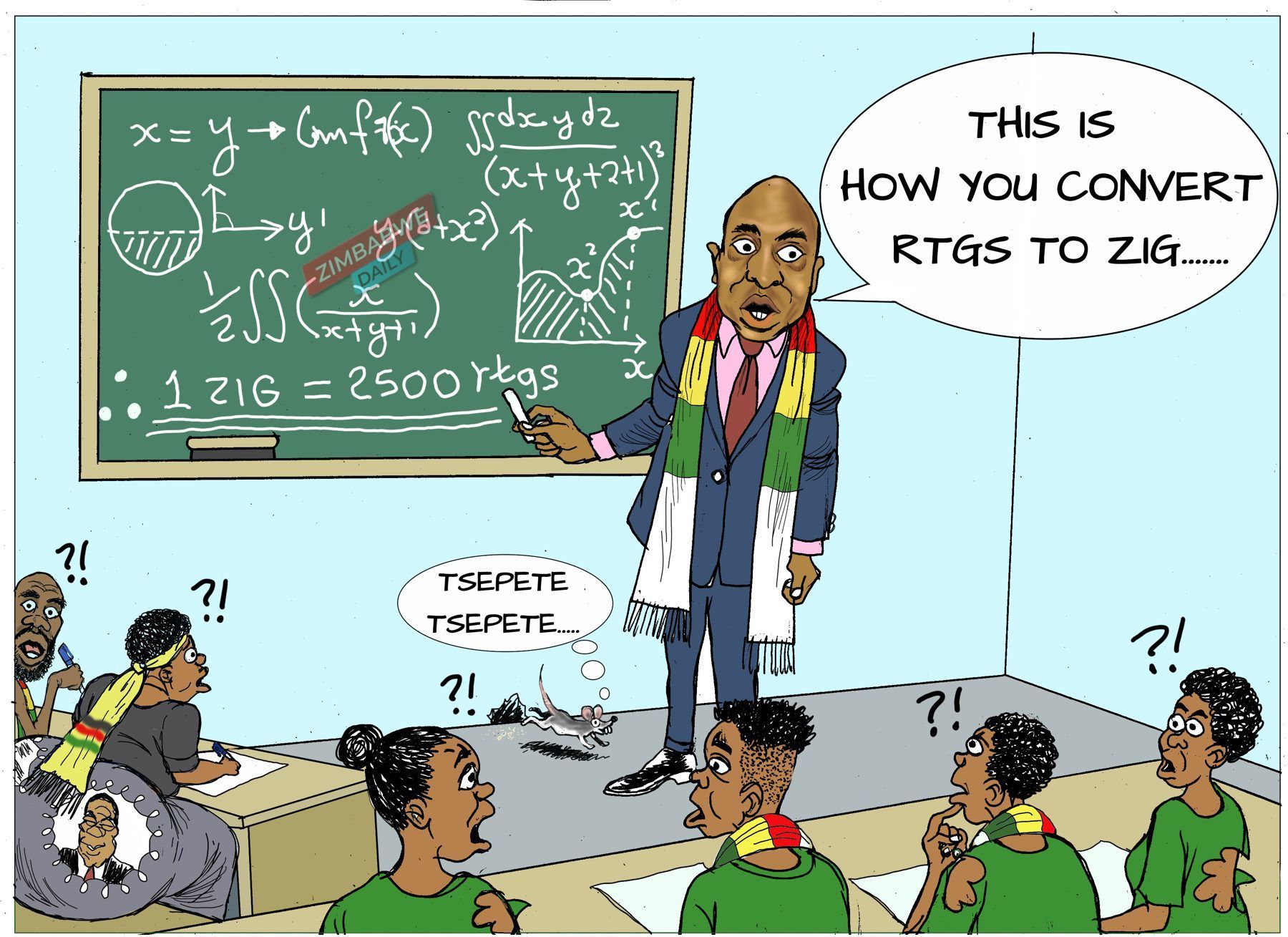
The cartoon accompanying this story captures the national mood: a teacher at a blackboard covered in calculus, scrawling “1 ZIG = 2500 RTGS” and assuring his bewildered class that this is how the conversion works. The real rate, to four decimal places, is not much easier.
The backing
What makes this attempt different, the central bank says, is the vault. According to official data cited by CITE, the ZiG is supported by reserve assets including 2.5 tonnes of gold, worth US$185 million, and US$100 million in cash, a total of US$285 million. The new notes, in denominations from 1 to 200 ZiG, enter circulation on Monday, 8 April. Coins, the BBC reported, will help overcome the shortage of US coins, which has seen people receive their change in sweets, small chocolates and pens.
The bank also cut its policy rate from 130 percent to 20 percent.
The memory
Mushayavanhu has promised that overprinting will not be allowed to happen again. Zimbabweans have heard similar promises. The BBC recalled the Z$10 trillion notes of 2008, and the bond note introduced in late 2016, which the then-governor John Mangudya vowed would stay at par with the US dollar, and which crashed when the government began printing excess money.
“We now end up in the same place where we started - where assurances are being given to the market that the government will live within its means,” the economist Godfrey Kanyenze told the BBC. “The political culture has not changed - the critical point is discipline on the part of the authorities.”
The US dollar, which accounts for 85 percent of transactions, remains legal tender. The BBC reported that most people are likely to continue to prefer it. Public reaction to the launch, it said, was subdued.
Into the deep end
A second cartoon from the launch fortnight shows a giraffe standing comfortably in water up to its neck, calling to the small animals on the shore to come in because “it’s not even deep”. It is an unkind picture of officials selling the currency to people with considerably shorter legs.
A third shows the new currency as a football on the penalty spot at Rufaro, facing a goal packed with defenders named Bad Politics, Corruption and Bad Governance. That is the cartoon’s view. Kanyenze’s warning, about discipline on the part of the authorities, makes a similar point in plainer language.
What comes next
Zimbabweans have 21 days to exchange their old notes. Companies will have to pay at least half of their taxes in ZiG on quarterly payment dates, according to CITE.
The ZiG’s fortunes will depend on whether the gold stays in the vault and the printing presses stay quiet. For now, the class is still copying the sum off the board.