HARARE - Most central banks let their currency speak for itself. Zimbabwe’s has taken it on a roadshow.
The Reserve Bank of Zimbabwe (RBZ) is midway through a nationwide education and awareness campaign ahead of the launch of its new Big5 ZiG banknote series on 7 April. The programme, titled “Meet the People”, had by 15 March reached 48 of the country’s 64 districts, covering 1,167 urban and rural centres and 610,541 participants, according to Ecofin Agency.
The campaign is meant to familiarise businesses and citizens with the new notes’ security features and to encourage wider use of the Zimbabwe Gold, the currency introduced in April 2024. It will continue through March on multimedia channels.
The 2030 destination
The roadshow is a step on a longer road. In September 2025 the RBZ said it was working towards a “mono-currency” system by 2030, with the ZiG as the sole legal tender for domestic transactions. Zimbabwe currently operates a multi-currency regime in which the ZiG circulates alongside foreign currencies.
The central bank stressed then that this would not be a redenomination but a gradual, “organic, market-driven approach”. Individuals and businesses will keep both ZiG and foreign currency accounts, though holders of foreign currency would need to convert to ZiG for local transactions. Banks would continue to meet legitimate foreign currency needs such as imports, travel and medical expenses.
The milestones the RBZ set included foreign reserves covering three to six months of imports, inflation reduced to single digits beyond 2026, and a parallel market premium kept below 30 percent.
“The journey which has already started will be supported by policy interventions that will ensure a gradual transition through widening the use of and demand for ZiG, long term stability of ZiG and availability of foreign curreny on the market,” the bank said, as quoted by Pindula News.
The pitch
At the roadshow, Governor John Mushayavanhu told audiences that the ZiG is backed by a composite of foreign reserves and gold. RBZ officials also reassured government suppliers, who are being paid increasingly in ZiG, that they will still be able to buy foreign currency on the willing-buyer, willing-seller interbank market.
The central bank argues that reliance on multiple foreign currencies has left the economy exposed to external shocks, exchange rate swings and inflation. Ecofin reported that inflation stood at 3.85 percent in February, down from 4.1 percent in January.
The cartoonist’s questions
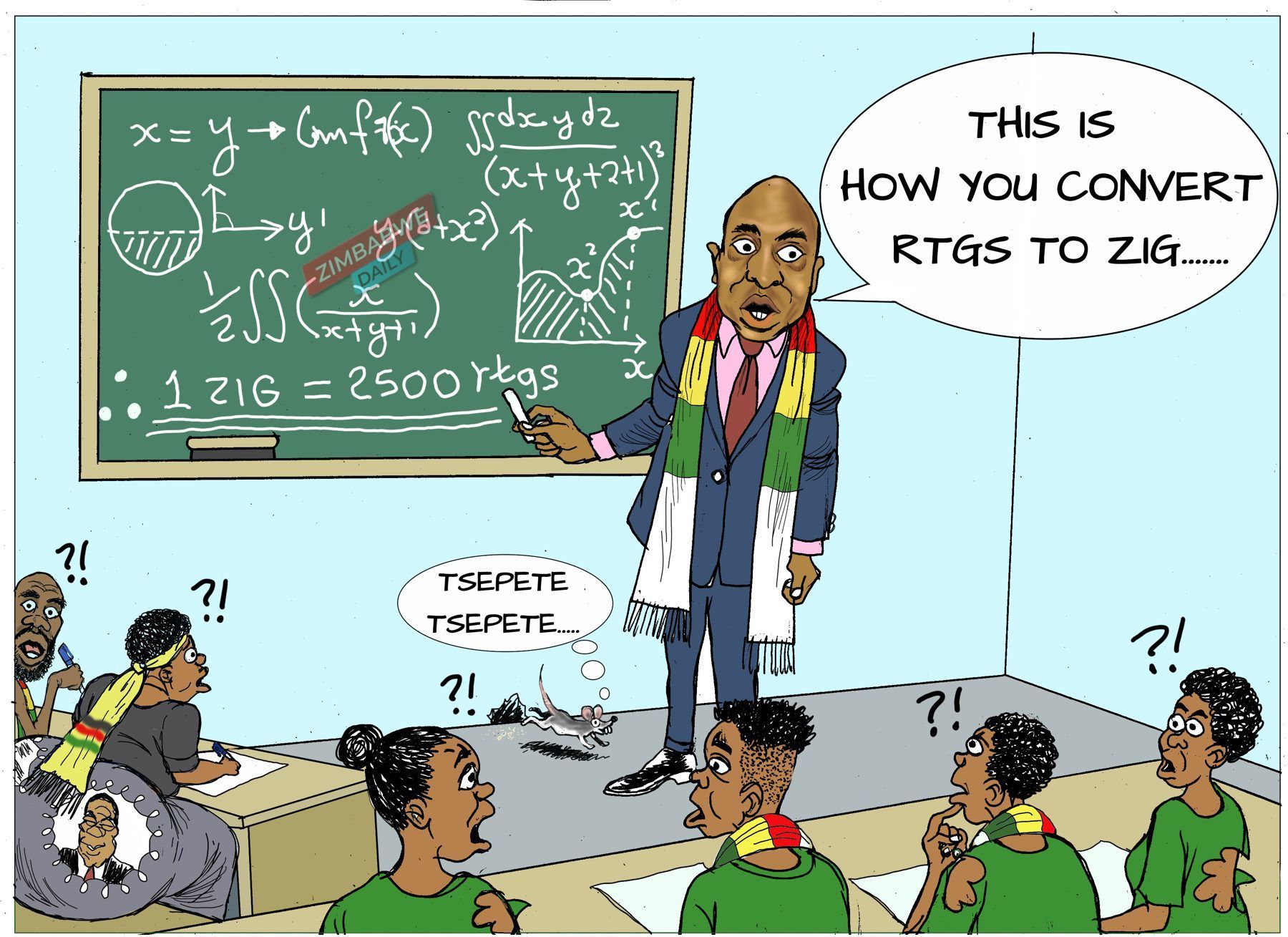
The cartoon at the top of this page asks the question the billboards invite: why is Zimbabwe “the only country in the world that advertises its money?” It is a fair joke.
Two older cartoons, drawn as the 2030 roadmap was announced last September, are less gentle. In one, a muscular US dollar holds the whole country on a platter above his head while a small ZiG smokes at his feet, next to the RBZ’s assurance that there will be no crisis after the dollar goes. In another, an ATM carries a notice that it does not dispense ZiG notes, while a well-connected man loads a sack with cash.
These are opinions, and pointed ones. They also describe the scale of the task. The RBZ’s own plan accepts that people will only “progressively adopt” the ZiG once they are confident in its stability.
What comes next
The Big5 notes arrive on 7 April. The real campaign, though, will run until 2030, and its audience is every Zimbabwean who still keeps savings in dollars.
The roadshow has reached 610,541 people so far. Converting them was always going to be the easy part; converting their savings is the sale that counts.