CAPE TOWN - For thirty years the African National Congress did not need anyone’s permission to govern South Africa. On Friday, as the new Parliament sat for the first time, it formally acknowledged that it now does.
The ANC won 40.18 percent of the national vote in the 29 May election, according to the Electoral Commission’s final results report, and 159 of the 400 seats in the National Assembly, SAnews reported. It had lost its controlling majority, the BBC reported, and had to negotiate to stay in office.
Its new partners include the Democratic Alliance, which won 21.81 percent and 87 seats. The pairing was “once considered unimaginable by many in South Africa,” the BBC’s Barbara Plett Usher wrote. The Inkatha Freedom Party and the smaller Patriotic Alliance have also confirmed they are on board, which means Cyril Ramaphosa will serve another term as president.
“Today, the 14th of June 2024 will go down in the annals of history as the start of a new chapter for our beloved country,” said DA leader John Steenhuisen in a statement in Cape Town.
The reaper in the gym
The biggest shock of the election was the party that came third. uMkhonto weSizwe (MK), led by former President Jacob Zuma, won 14.58 percent nationally, according to the Electoral Commission. In KwaZulu-Natal it topped the regional ballot for the National Assembly with 44.91 percent of the vote, SAnews reported.
One of the cartoons that followed captured the mood: an ANC weightlifter crushed beneath a barbell marked “30 year dominance since 1994”, while a hooded reaper labelled “MK” leans on the bar. The scythe is artistic licence. The arithmetic is not.
MK and the Economic Freedom Fighters, which came fourth, are not part of the new arrangement. The EFF rejected a government that included the DA, and MK, which rejects the constitution, did not meet the criteria for joining, the BBC reported. MK also tried to block Friday’s parliamentary sitting through a legal challenge that the Constitutional Court threw out.
Not 1994
South Africa last had a national unity government in 1994, negotiated by Nelson Mandela. The BBC drew the distinction: then, the ANC reached across the divide from a position of strength; now it does so from a position of political necessity.
TK Pooe, of the Wits University School of Governance, put it more bluntly. “This is not a government of national unity,” he told the BBC. “It’s just a bit of camouflaging so that people don’t have to own that it’s a grand coalition.”
ANC secretary-general Fikile Mbalula insisted that the party had not changed. “No party is going to die,” he told journalists. “The ANC is not going anywhere.”
The visitors from the north
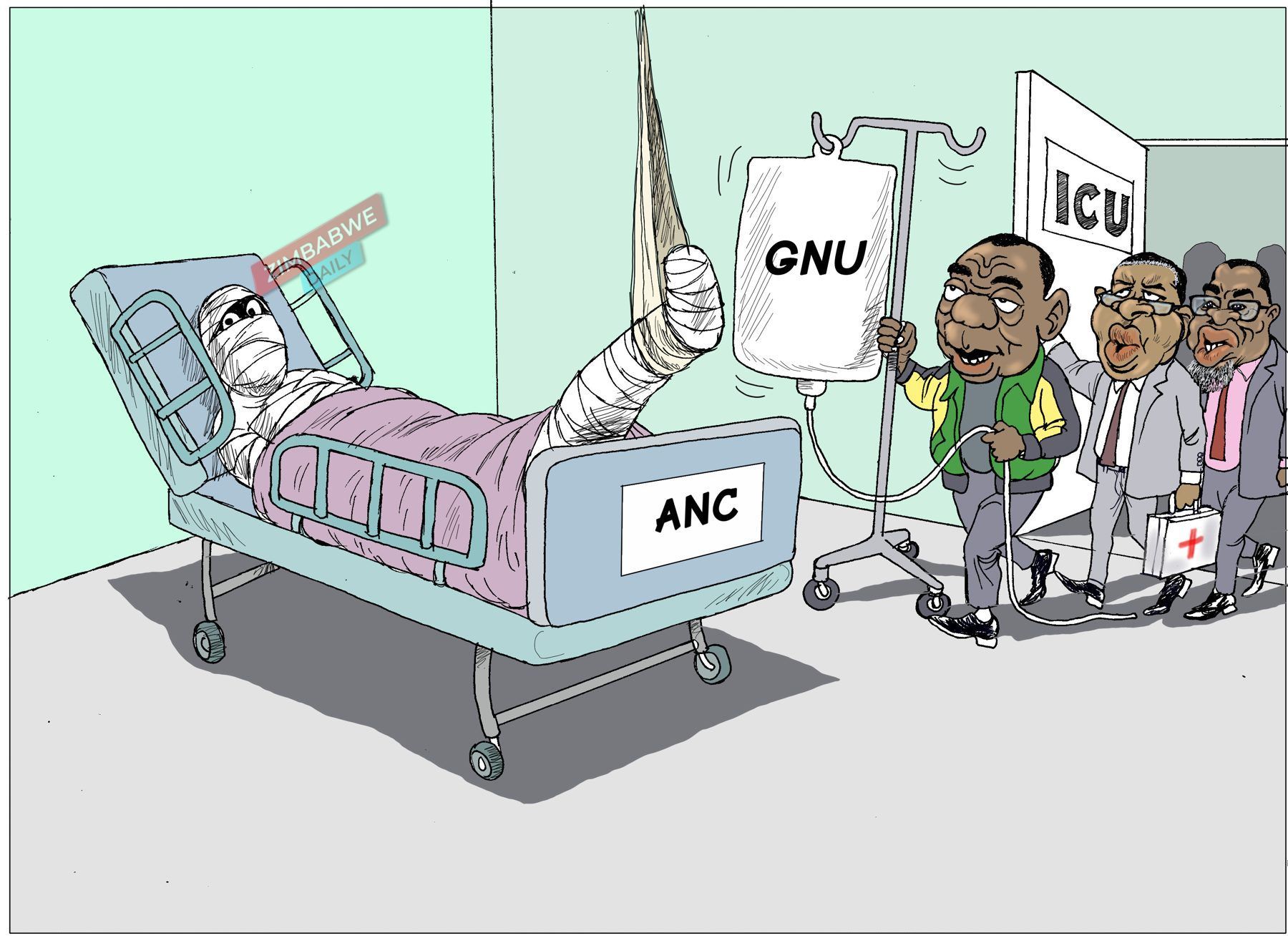
The second cartoon puts the ANC in intensive care, bandaged from head to toe, a leg in traction and a drip labelled “GNU” in its arm. Through the ICU door come visitors in the scarves of Zimbabwe’s ruling party, bearing a first-aid kit.
It is a joke, not a diagnosis, and the ANC is far from dead. But it raises a fair question for the region. When a liberation movement of the ANC’s stature shares power after losing a vote, its counterparts next door can read it as a lesson or as a warning.
What comes next
The detail of who gets which cabinet posts is expected in the coming days. The harder test is whether a coalition of old adversaries can agree on policy. The BBC identified the DA’s opposition to the ANC’s national healthcare policy and its black economic empowerment programme as the most contentious issues.
Derek Hanekom, who served in Mandela’s original unity government, believes the differences are sometimes overemphasised. “The parties are ready to make compromises and be flexible,” he told the BBC.
South Africans have voted for a government that has to talk to itself. For a region more used to one-party certainty, that is the most interesting experiment of the year.