CAPE TOWN - Cyril Ramaphosa’s State of the Nation address on Thursday travelled a long way. It went to Palestine, to Cuba, to Sudan and to Western Sahara. It did not, as far as the official text shows, stop in Zimbabwe.
“We cannot consider ourselves free for as long as the people of Palestine, Cuba, Sudan, Western Sahara and elsewhere suffer occupation, oppression and war,” the president told Parliament, in a line the Mail & Guardian reported alongside his promise that South Africa would remain “a clear and consistent voice for international law, for justice and for human rights”.
He was equally firm on sovereignty. “In a world where powerful nations often assert their dominance and influence over less powerful states, our country’s commitment to sovereignty and self-determination is sacrosanct. It is not negotiable,” he said. “We will not be bullied by any other country.”
Where Zimbabwe appears
The text of the speech published by the South African government names the African Union and the Southern African Development Community as vehicles for “regional integration, peace and stability”. It does not name Zimbabwe.
Zimbabweans do appear, if indirectly, in another section. “Illegal immigration poses a risk to our security, stability and economic progress,” Ramaphosa said. He promised more funding for border security, redeveloped border posts, wider use of drones, an additional 10,000 labour inspectors, and “the full might of the law” for employers who hire foreign nationals without visas.
He also said: “We will not tolerate violence and other acts of lawlessness directed at foreign nationals. No foreign national should be unlawfully barred from accessing public facilities, including schools and health facilities.”
That is a welcome sentence for the many Zimbabweans living south of the Limpopo. It is a sentence about how they are treated once they arrive, not about why so many of them left.
The old criticism
The contrast is not a new one. ZimEye, in an analysis published after the speech, set the Palestine line beside the South African Presidency’s statement of 3 August 2018, which said Ramaphosa, as SADC chairperson, “has called and congratulated Mr Emmerson Mnangagwa” after that year’s election.
It also recalled the Democratic Alliance’s response when Ramaphosa attended Mnangagwa’s inauguration in September 2023. “Ramaphosa’s endorsement of Mnangagwa is an endorsement of Zimbabwe’s suffering,” the DA said at the time, in a statement issued by its leader John Steenhuisen. The party accused the ANC of being removed from “the plight of the Zimbabwean people”.
Those are the words of a political opponent. But they show the argument is not only made in Harare.
The cartoons’ telescope
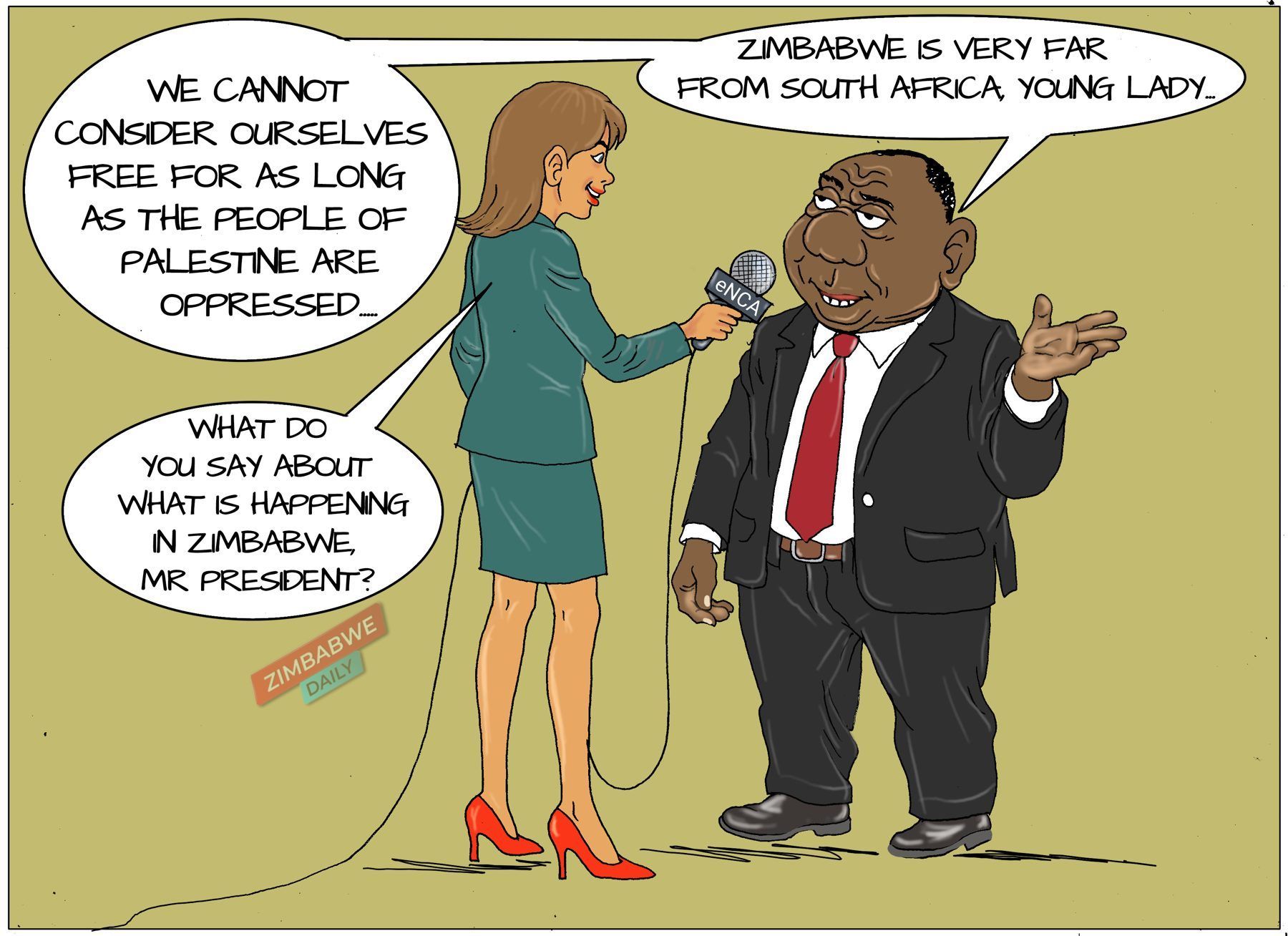
A cartoon published days after the speech has a reporter asking the president, fresh from his Palestine line, what he says about Zimbabwe. “Zimbabwe is very far from South Africa, young lady,” he replies. Ramaphosa never said that. It is satire, and its joke is geography: Zimbabwe shares a border with South Africa, and Gaza is a continent away.
A second cartoon makes the same point from the migrant’s side. A man is made to skip between two ropes, one marked “Zanuphobia” (demolitions, a vending ban, repression) and the other “Xenophobia” (deportations, attacks, arrests). It is a bleak picture of a citizen squeezed by home and host at once.
What comes next
Solidarity with distant peoples is a long tradition in South African foreign policy, and a proud one. The harder test of that tradition is closer to home, where the oppression is less televised and the people fleeing it arrive by bus.
For now, Zimbabweans listening to Thursday’s speech heard a lot about borders and drones. They did not hear their country’s name.