HARARE - Mthuli Ncube has a nautical theory of economics. Do not rock the boat.
The Finance Minister presents his Mid-Term Budget Review to Parliament today, and he has been lowering expectations in advance. “I do not expect dramatic changes or policies; we want to keep things as they are,” he told the Zimbabwe Industrialisation Conference and Expo, according to Pindula News. “The ship is sailing steadily; do not disturb it.”
His case is that the economy is finally calm. “We have stability in the economy right now; we have the lowest inflation rate in both local and foreign currency,” he said. “We have fiscal and monetary discipline, good coordination, and it is showing in the rest of the economy, and the economy is going strong.”
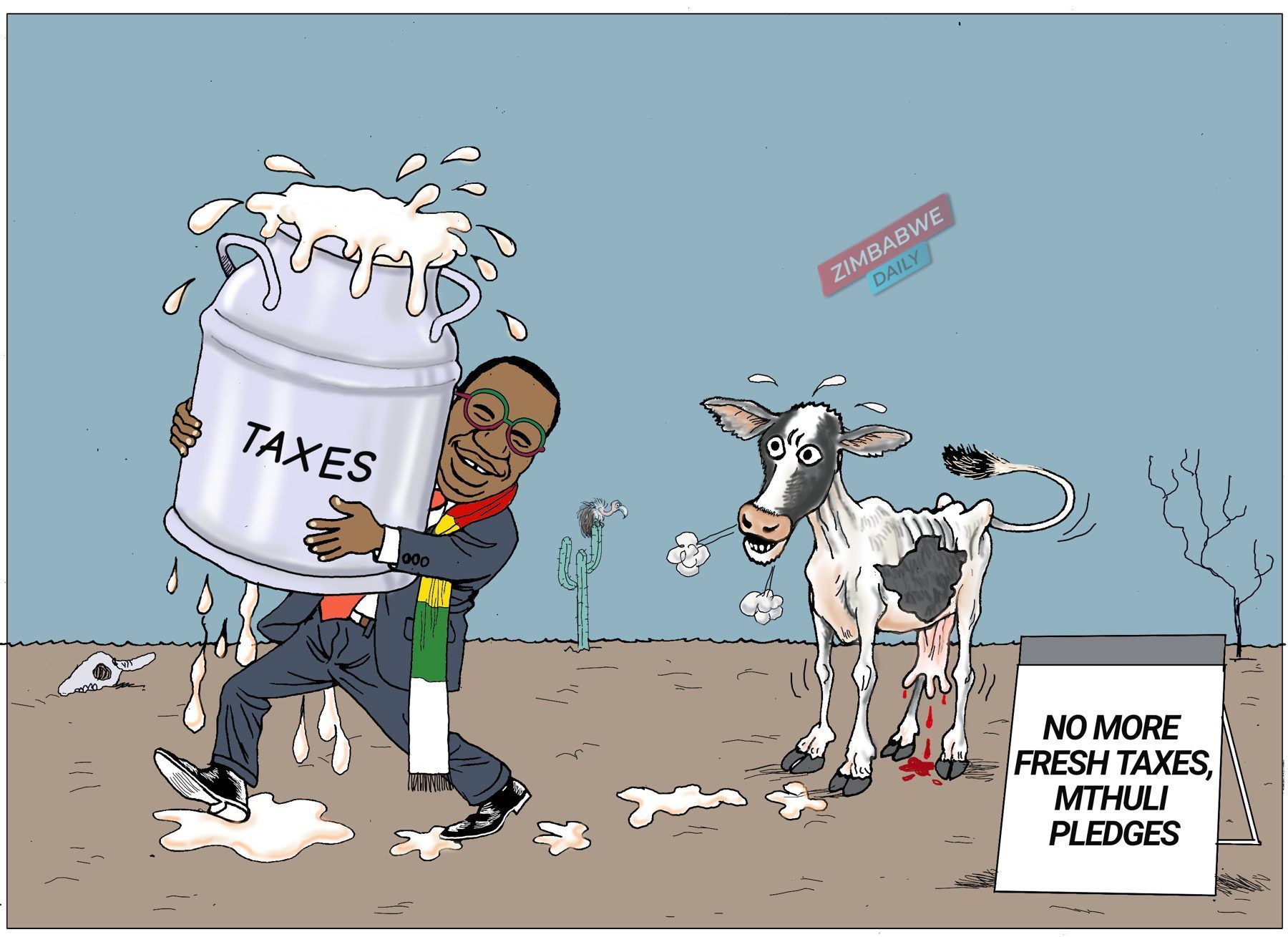
Earlier in July, speaking in Parliament, Ncube pledged that authorities would hold the line on taxes and avoid supplementary budgets next year, to protect households and businesses from economic uncertainty, the Daily News reported under the headline “No fresh taxes, Mthuli pledges”.
The taxes already in the churn
No fresh taxes is not the same as fewer taxes. Techzim noted in April that the government had recently introduced a Digital Services Withholding Tax, which it said levies a 15.5 percent charge on almost all online payments.
The cartoon accompanying this story makes the point with dairy. A minister clutches an overflowing churn marked “Taxes” while the cow beside him is mostly ribs. The pledge sign reads “No more fresh taxes”. The cow is the cartoonist’s comment on the taxpayer. Holding the line, after all, means keeping the taxes already in place.
ZIMRA’s open door
While the Treasury promises calm, the Zimbabwe Revenue Authority is widening its net, politely. In April, under Public Notice 25 of 2026, ZIMRA invited taxpayers to voluntarily disclose income they had not declared for the 2025 year of assessment. Where a full and truthful disclosure is made, the notice said, “the Commissioner shall waive the penalties in full, and such disclosure shall not automatically trigger an audit or prosecution.” Interest still applies.
The list of who should come forward read like a portrait of the modern Zimbabwean hustle: people who earn income from online platforms or digital services, rent out property, trade gold, run taxis, deal in crypto assets, or earn from foreign companies while living in Zimbabwe. It also included anyone with “significant assets or developments inconsistent with their tax declarations”, a category that may make some homeowners read twice.
The original deadline was 30 June. On 15 July, in Public Notice 42, ZIMRA extended it to 30 September “after extensive engagements with taxpayers and taxpayer representatives”. The new list adds those who operate “inn drives”, presumably a rendering of the ride-hailing app InDrive.
The influencers’ complaint
Techzim reported that early coverage had focused on content creators, and skit makers in particular. A second cartoon captures their reaction, with a crowd of social media personalities gathered under a banner reading “ZIMRA goes after content creators”, one asking why ZIMRA cannot “just monetize its own page and leave us alone?”
The notice itself never mentions influencers by name. It does not need to. Anyone earning from online platforms is in scope, and the deadline is now 30 September.
What comes next
Today Ncube presents a review he has promised will change little. That may be welcome to businesses tired of policy surprises. For those who have not yet filed their disclosure, the firmer message is from ZIMRA: there are two months left before the amnesty ends and, in the words of the original notice, non-compliance “will be treated in accordance with the full provisions of the tax laws.”