HARARE - The Zimbabwe Defence Forces gathered at Rufaro Stadium on Tuesday, and their Commander-in-Chief put on his best adjectives.
Presiding over the 46th Zimbabwe Defence Forces Day, President Emmerson Mnangagwa commended the forces “for remaining steadfast, loyal, patriotic, disciplined and exemplary in the execution of their mandate,” according to the text of his speech published by ZANU-PF. He challenged the ZDF “to evolve, innovate and adapt in line with the needs and national interest of our beloved motherland, Zimbabwe.”
The theme this year was “Zimbabwe Defence Forces: Guaranteeing Peace and Stability for the Attainment of Vision 2030”. In his opening lines, the President said the country stood “strong as a united and peaceful country, with the Zimbabwe Defence Forces guaranteeing the harmony and tranquility that has become synonymous with the Second Republic.”
A People’s Army, upgraded
The speech was largely about modernisation. Mnangagwa said Zimbabwe was “expediting the modernisation of defence systems and capabilities,” called for stronger cyber security and preparation for the impact of artificial intelligence on defence, and said his government stood ready to support a “science and technology driven National Defence Industry”.
He praised the military’s farms, its school and clinic building in Rushinga, Buhera, Gokwe, Mutasa North and Harare, its de-mining work, and joint border operations with the police. He also invoked the army’s political character. “The ZANU PF Government is people-centred, likewise, the sacred characteristic of the Zimbabwe Defence Forces as a People’s Army, should never be tainted,” he said.
Meanwhile, at the NCA
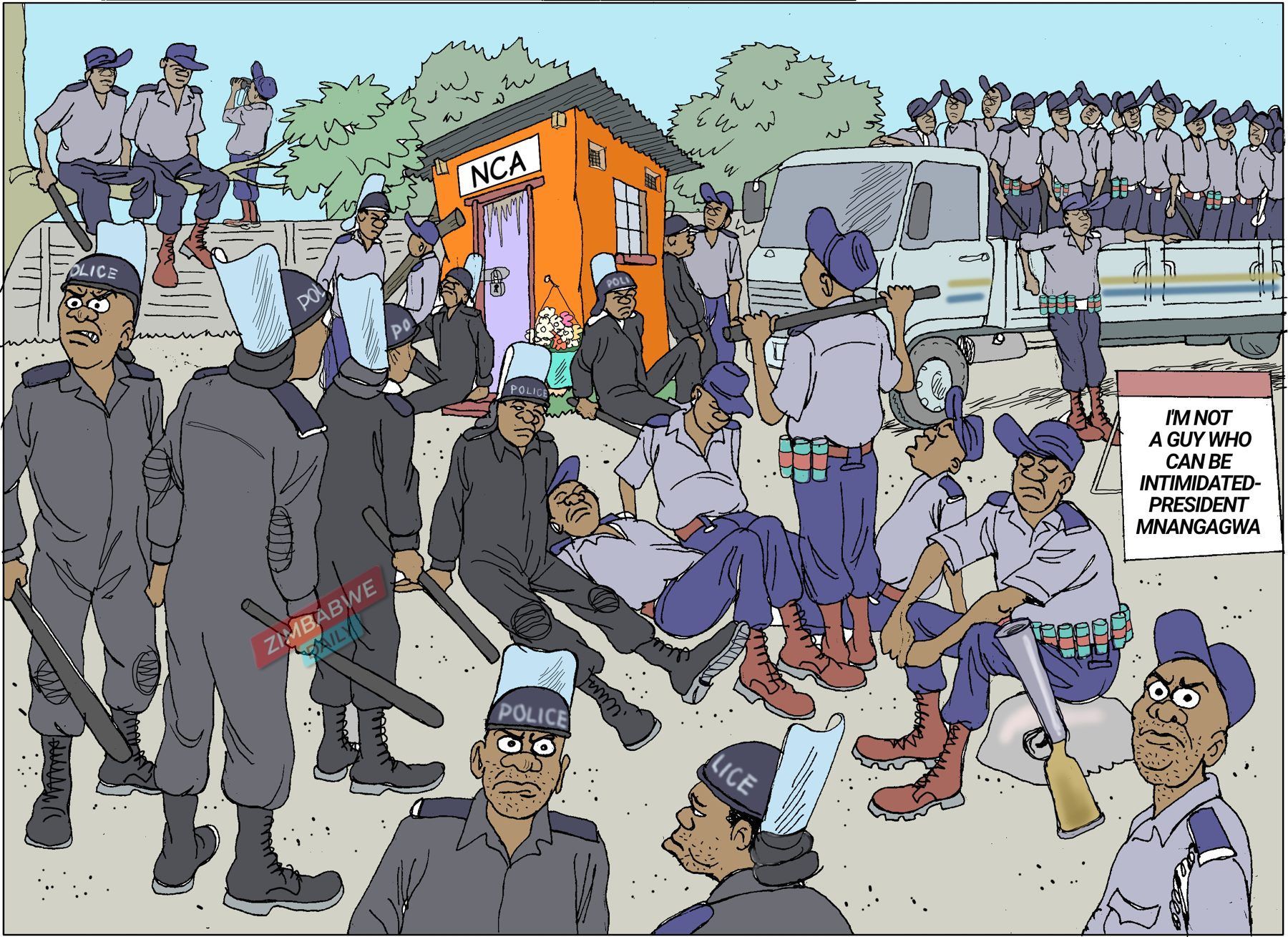
The parade was the more photogenic of the security forces’ winter engagements. The less photogenic one took place a month earlier at the head office of the National Constitutional Assembly in Harare.
NCA president Professor Lovemore Madhuku said on 14 July that the authorities had sent more than 50 police officers to stop a party leadership meeting about the Constitution Amendment (No. 3) Act, Nehanda Radio reported. “Today the regime deployed over 50 police officers at the NCA Head Office to block the holding of a leadership meeting, but it FAILED in its tracks,” he wrote on X. “The NCA meeting proceeded at a venue unknown to the oppressors.”
Nehanda Radio reported that there was no immediate response from the Zimbabwe Republic Police to that allegation.
It was not the NCA’s first brush with uniformed or un-uniformed attention. On 1 March, according to the same report, unidentified men in balaclavas forced their way into the party’s headquarters and attacked participants at a consultative meeting on the amendment. Madhuku was treated in hospital and alleged that police officers in two parked vehicles did not intervene. Police denied involvement. “No police personnel were deployed to oversee or monitor the meeting in question,” national police spokesperson Commissioner Paul Nyathi said at the time.
The view from the drawing board
One of the cartoons here shows riot police lounging around a tiny NCA hut, beneath a placard declaring “I’m not a guy who can be intimidated”. The other wishes the nation a happy Defence Forces Day in two panels: elsewhere, a child hugs a soldier and thanks him for protecting the family; in the Zimbabwe panel, civilians run from one, leaving their shoes behind.
Both are commentary. The facts are simpler. The President told the forces their task was to guarantee peace and stability, and that the people “remain at the core of all our activities”. Madhuku has said the fight against CAB3 is now in “TWO battlegrounds: courts and peaceful political resistance.”
Between those two statements sits the question every Defence Forces Day invites and no parade quite answers: what a guarantee of “peace and stability” means for citizens who would like to hold a meeting the state would rather they did not. On Tuesday, at least, the only thing being marched on was the Rufaro turf.