LUSAKA - Zambia has done what Zambia has done since 1991: counted the votes, announced a winner and argued about it afterwards in court rather than in the street. Mostly.
President Hakainde Hichilema has been re-elected for a second five-year term after winning 60 percent of the vote in last week’s election, the Electoral Commission of Zambia announced, the BBC reported. His closest challenger, Brian Mundubile, took 38 percent. Twelve other candidates trailed far behind.
“We are truly humbled by the trust you have placed in our hands,” Hichilema, 64, said after he was declared the winner. He described Zambia as a “democratic nation that settles our differences at the ballot box, and nowhere else.” To those citizens who preferred his opponents’ ideas, he said, “we hear you, and we will continue to work for you.”
Hundreds of supporters in the red of his United Party for National Development filled the streets of Lusaka to celebrate.
The other side of the result
It was not a tidy election. Mundubile, 55, said the results were not “a true reflection of what took place across this election,” and promised a legal challenge. “We have evidence. We have records,” he said. “We will now place that evidence before the appropriate legal institutions and pursue every lawful avenue available to us within the prescribed period.”
His party, the NRPUP, told the BBC that Mundubile had gone into hiding in a “secure location under the protection of an international human rights body due to threats made against him.” Some leading opposition figures were arrested in a raid on Friday and accused by the authorities of plotting an insurrection. Mundubile called the claim a fabrication.
He said armed men had broken into his home in Lusaka and that a former minister, Mutotwe Kafwaya, was shot there and was still missing. Mulambo Haimbe, Hichilema’s election agent, told the BBC that Mundubile’s account of the incident was “not correct”, and said criminal charges were being brought against those arrested.
Mundubile urged calm. “I ask every supporter of our party… to remain calm. Do not allow anger to destroy what we have built,” he said.
What the observers saw
The electoral commission briefly suspended counting a day after polling, citing violence against polling staff and the theft of marked ballot papers in some areas, the BBC reported. Counting resumed the same day.
Observers described polling day as largely peaceful but raised concerns about late electoral reforms and media access. Samuel Tembenu, the former Malawian minister who led the Southern African Development Community observer mission, said his team had “recorded, but could not verify, reports of intimidation, assault, abduction and damage to property in five provinces,” according to AFP, as quoted by the BBC. The European Union’s mission warned that restrictions on the opposition may have contributed to an “uneven contest”.
The view from the south bank
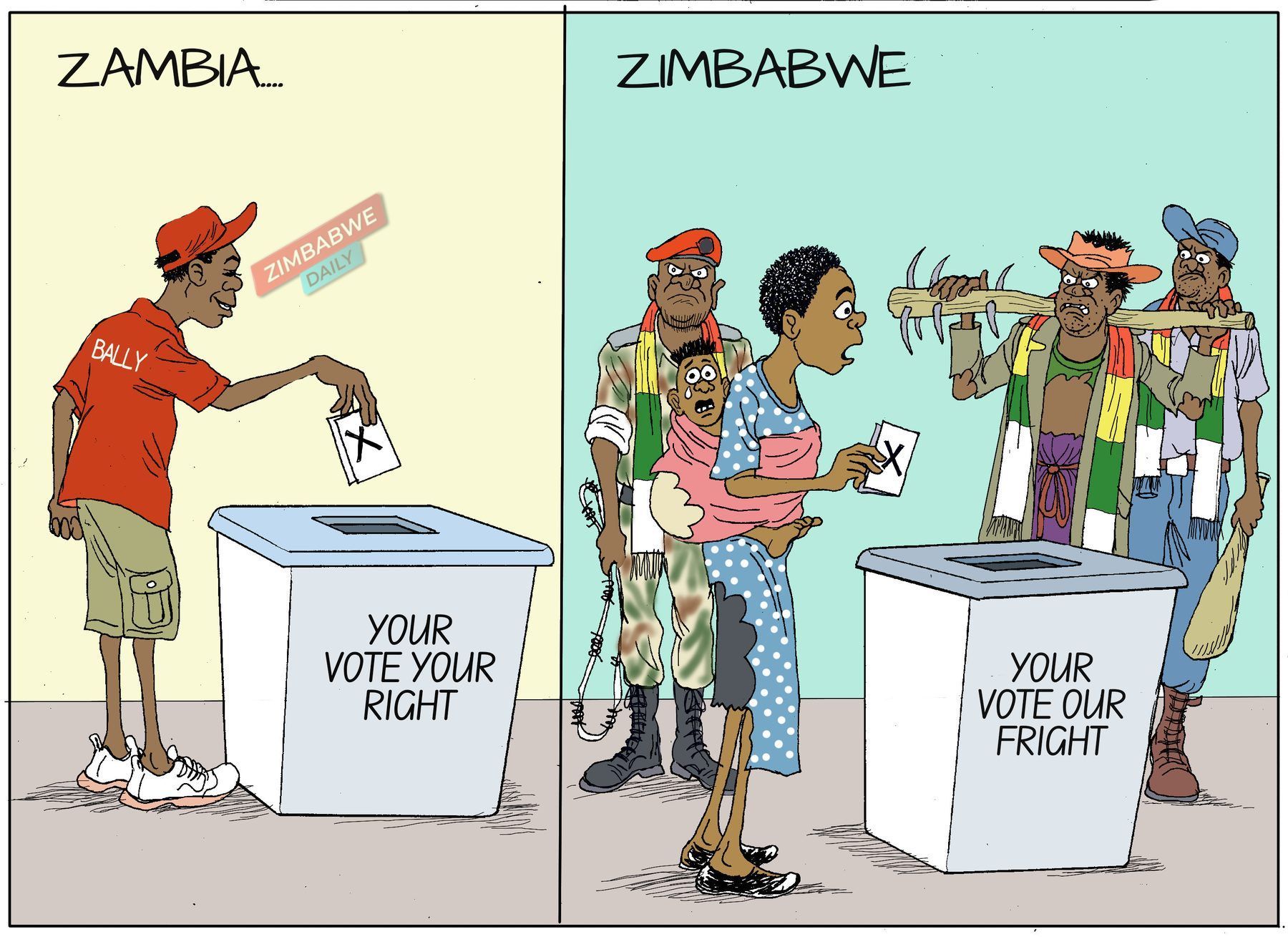
Zimbabwe’s cartoonists were less interested in these caveats than in the contrast with home. On polling day one of them drew a split panel. On the Zambian side, a relaxed man in a shirt reading “Bally” drops his ballot into a box marked “Your vote your right”. On the Zimbabwean side, a frightened mother with a baby on her back votes under the eyes of men with sticks and a soldier, into a box marked “Your vote our fright”.
It is a caricature, and an unkind one, of both countries. Regional observers recorded reports of intimidation in Zambia too.
A second cartoon shows Hichilema as a boxer with a “2nd Term” belt, the referee counting “58..59…..60%” over a bloodied opponent. Around the ring, the crowd chants “Bally!”
What comes next
Mundubile has said he will pursue every lawful avenue within the prescribed period, and the courts, Haimbe said, will deal with any challenge. Zambia has a record of peaceful transfers of power since multiparty democracy returned in 1991, the BBC noted.
For Zimbabweans watching from across the river, the result was less important than the routine: an incumbent who campaigned, a challenger who complains in court, and voters who expect both to accept the referee’s count.