HARARE - Zimbabwe Newspapers (1980) Limited, the publisher of The Herald and the country’s largest media group, has announced mandatory retrenchments as it reinvents itself as what it calls a “digital-first organisation”.
Executives told workers’ representatives at a meeting in Harare on Wednesday that 154 jobs would go in the first phase, according to Pindula News and The Zimbabwean. The company’s public statement did not give a number. Zimpapers employs more than 900 people across newspapers, radio, television and printing.
What the company said
Board chairperson Doreen Sibanda said the restructuring followed a review of the group’s operations in light of technological change, shifting media consumption and the need for long-term competitiveness. The television arm, Zimpapers Television Network (ZTN), will move from traditional linear broadcasting to a digital Over-the-Top (OTT) platform. The newspapers division will be realigned into a “digital- and mobile-first operating structure”.
“As a result, certain positions have become redundant within the revised operating model, and the company has commenced a retrenchment process in compliance with applicable labour laws and established human resources procedures,” Sibanda said, as quoted by The Zimbabwean. She said the company remained “committed to treating all affected employees with fairness, dignity and respect throughout the process”.
Zimpapers said it would immediately notify the National Employment Council and the Retrenchment Board, after which affected workers would receive their letters.
The reshuffle has already reached the editors’ offices. Sunday News editor Hatred Zenenga is now also editing The Chronicle, after Lawson Mabhena moved to Harare as head of news for all Zimpapers titles.
What the numbers say
The company’s 2025 full-year results, as analysed by Equity Axis and carried by The Zimbabwean, help explain the timing. Revenue fell 15.5 percent to ZWG 622.1 million. The loss from operations more than quadrupled, from ZWG 17.3 million to ZWG 74.6 million. The loss after tax reached ZWG 83.5 million, up from ZWG 21.7 million.
“No division is carrying the group,” Equity Axis noted. The newspaper division swung from a ZWG 9.2 million operating profit to a ZWG 10 million loss. Advertising volumes fell 14 percent. Commercial printing revenue fell 44 percent. Broadcasting was the only segment to improve, with its operating loss narrowing to ZWG 17.6 million on a 45 percent rise in radio volumes, even as ZTN volumes fell 35 percent.
By the end of the year, Zimpapers had ZWG 5.4 million in cash, half the previous year’s figure, and a new bank overdraft of ZWG 4.6 million. No dividend was declared.
Zimpapers is listed on the Zimbabwe Stock Exchange. The government-controlled Zimbabwe Mass Media Trust owns 51 percent; other shareholders include Old Mutual and investment companies linked to the businessman Nicholas van Hoogstraten.
A familiar story, with a local twist
None of this is unique to Harare. Newspaper groups around the world are facing falling print circulation and advertising as readers move online, and Zimpapers is under the same structural pressure.
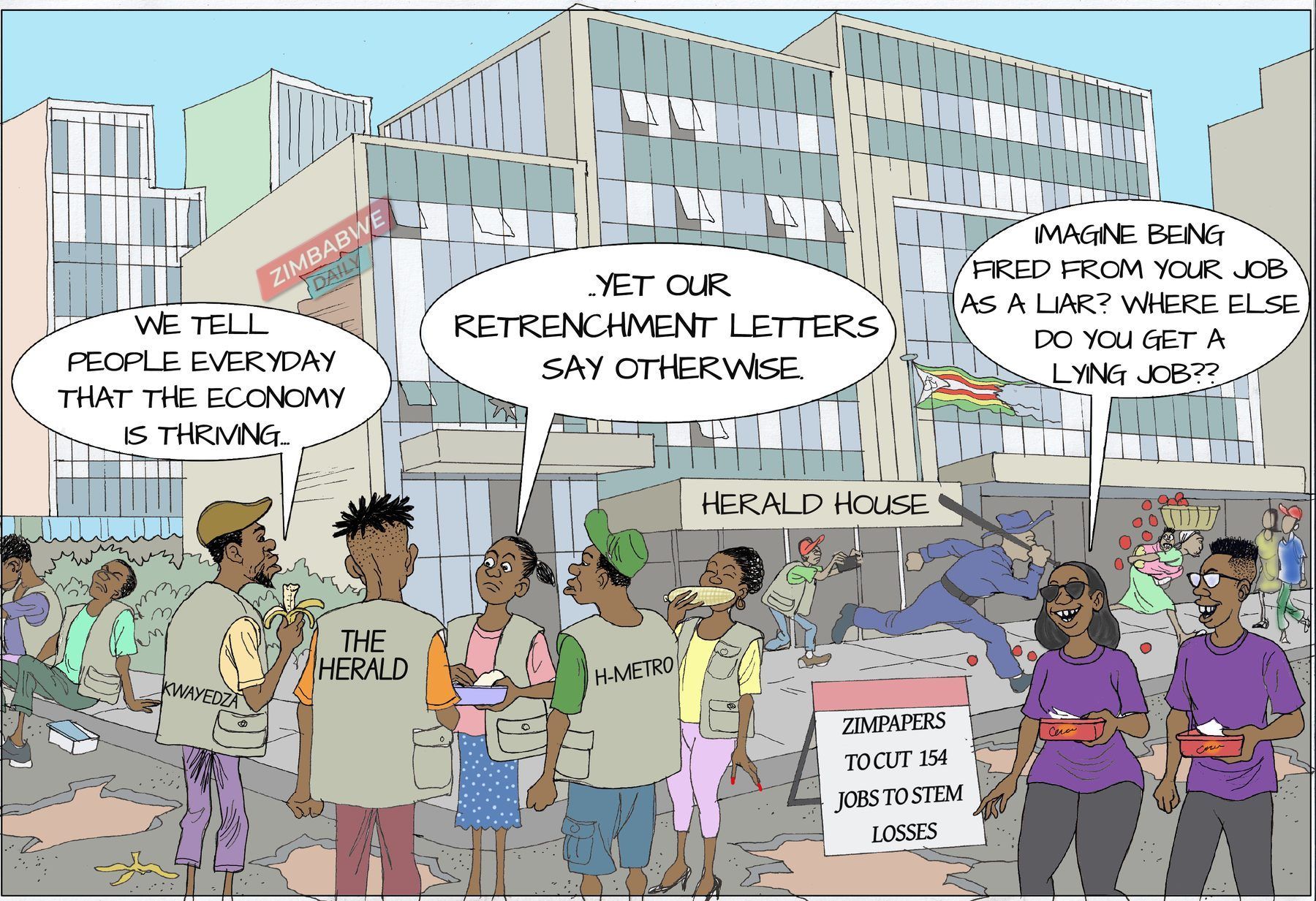
What gives the story its local edge is the masthead. The Herald is the flagship of a group whose majority owner is a government-controlled trust. The cartoon accompanying this story seizes on that without mercy, with staff outside Herald House noting that they tell readers every day that the economy is thriving, “yet our retrenchment letters say otherwise.” The jibe is the cartoon’s. The letters, once the Retrenchment Board is notified, will be real.
A second cartoon, of a graduate carried shoulder-high in celebration and then confronted with a padlocked, cobwebbed door marked “Employment”, makes the wider point without words. Each job cut at Herald House adds one more person to that queue.
What comes next
Zimpapers describes this as a first phase. The company says it will continue delivering content to its audiences, advertisers and shareholders through the transition.
For the 154, the transition is more immediate. They have spent their careers telling the nation’s stories. This week the story was about them.