HARARE - Sunday in Zimbabwe is a day of rest, worship and, increasingly, news.
In Harare this weekend, Vice-President Constantino Chiwenga became a full member of the Roman Catholic Church’s St Joseph’s Guild at an investiture ceremony, The Herald reported, as carried by Bulawayo24. Admission follows religious instruction, formation classes and a spiritual retreat; the Vice-President completed a three-day retreat the weekend before. His wife, Colonel Miniyothabo Chiwenga, his daughter Tendai and his sons attended.
ZimEye reported that his five sons were also admitted as full members, and that after the investiture Chiwenga and his sons “joined fellow guild members in collecting tithes.” The Herald’s account, as carried by Bulawayo24, does not mention the collection.
On the same weekend, across town, the United Family International Church founder Emmanuel Makandiwa told his congregation that he would now accept a gift from Wicknell Chivayo that he had earlier declined. “Leaving this place we are already expecting that the gentleman will bring our gift. The gifts are there. I’m the one who had not collected. We will receive them, pray for you and bless you,” he said, according to Nehanda Radio.
Faith is not the problem
Let us be clear about what is not at issue. A Vice-President is entitled to his faith, and to serve his parish. The St Joseph’s Guild, as The Herald describes it, is a Catholic men’s association that encourages members to strengthen their faith, support their families and serve their communities. ZimEye itself noted that there is “no evidence linking Sunday’s church investiture or the public appearance of Chiwenga and his sons to internal ZANU PF succession dynamics.”
Nor is it illegal for a church to accept a donation. Chivayo describes his giving as voluntary philanthropy, and Nehanda Radio reported that he has said those who decline it are free to do so without ill feeling.
The picture is the problem
But churches are not only places of worship. They also claim a moral voice, and that voice depends on distance from the powerful.
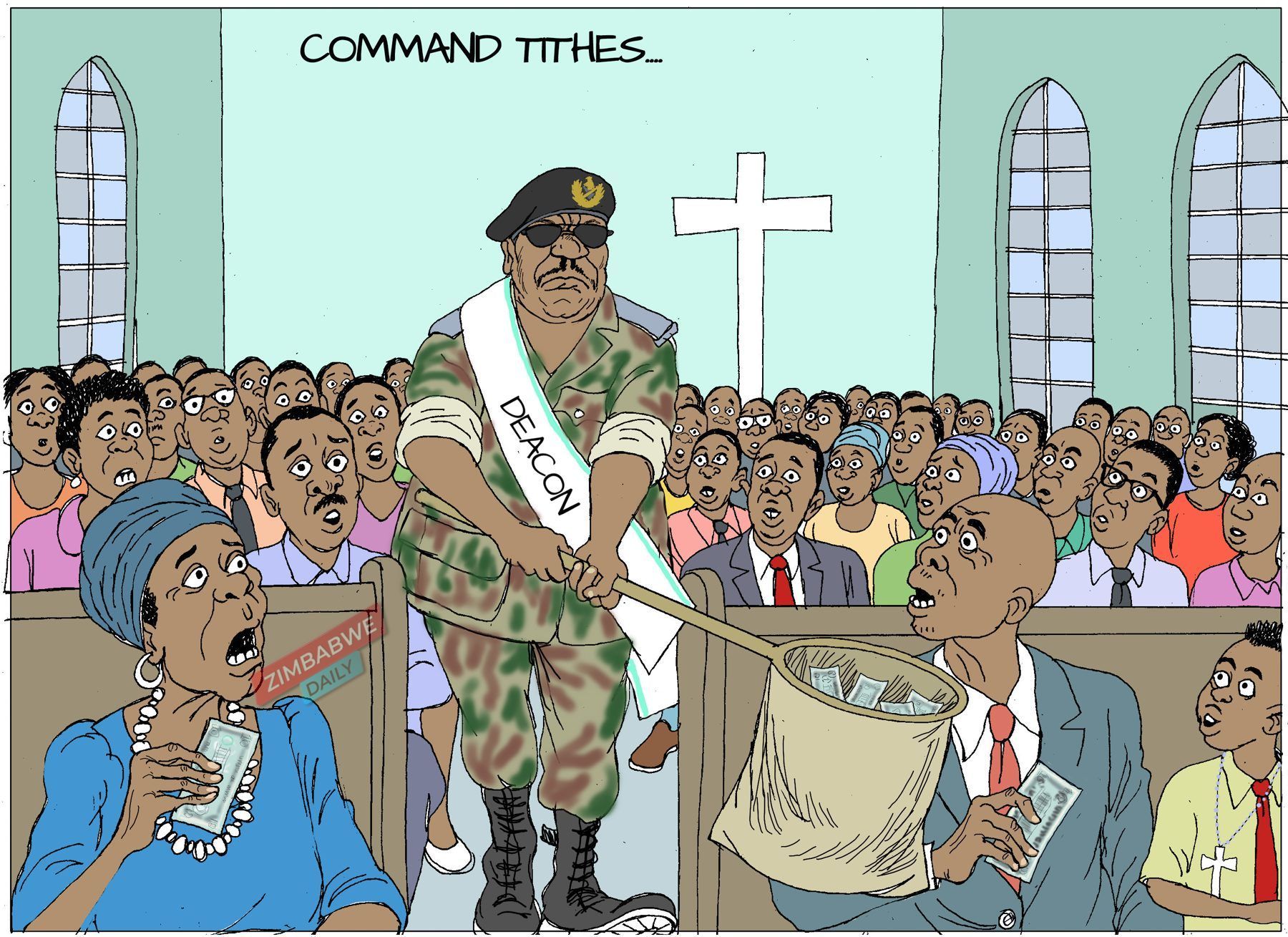
The cartoon at the top of this page, titled “Command Tithes”, imagines a man in camouflage and a deacon’s sash pushing a collection net at frightened worshippers. It is unfair to the guild, which asks humility of its members, and it is the cartoonist’s view, not a report. Chiwenga is a former military commander, which is the joke. But it captures an anxiety that is real: when the most powerful men in the land hold the collection net, who in the pews feels free to put in nothing?
The second cartoon, “Trading Soul For Fortune”, is harsher still: a kneeling figure labelled “Men of Gold” licks the shoe of a tycoon on a throne, next to a pulpit. That is satire and should be read as such. It is not a description of any named pastor.
The prophet’s change of heart
Makandiwa had earlier turned the gift down. He said his refusal had been a matter of principle and not a response to public criticism of Chivayo, Nehanda Radio reported. He is not the first cleric to accept the businessman’s generosity, and the story of what he received, and how it was presented, will run on. For this column, the point is narrower.
Chivayo rose to prominence after his company won a government contract for the Gwanda solar project in 2015, Nehanda Radio noted, and was acquitted in 2024 of fraud and money laundering charges linked to it. He is entitled to give, and the courts have cleared him. But when the most generous donor in the pews rose to prominence on a government contract, a pastor’s gratitude is never only private.
The question for the pulpit
None of this is a scandal in the legal sense. It is something subtler. A church that receives from the powerful, and is seen to, must work harder to be heard when it needs to say no to them.
Refusal is possible: Makandiwa himself managed it, for a while. The clergy who keep their distance may find, in time, that it was also cheaper.